I’ve remarked on this before—perhaps I was slightly sarcastic or even cynical—talking about the biohacker herd who are doing weird extraordinary things which they hope will enable them to live extraordinary long lives.
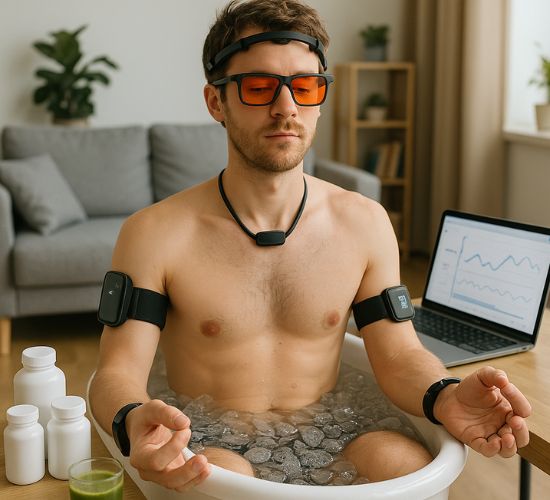
I doubt it.
Why do I say that? Because they are barking up the wrong tree. We don’t age due to lack of supplements. Deficiencies can have a devastating effect, true. But aging is really a process: feeling tired, running down, losing momentum and it’s THAT that will carry you over the cliff edge, if you are not careful.
You have to have a REASON to live long and just a fear of dying doesn’t cut it. We are self-propelling organisms and can work our way past most barriers. Human ingenuity is mythic! But there has to be a reason: a WHY.
Proverbially, people until the last half-century, would retire and then quickly wither away and die. It was a given! The reason pensions were originally timed for the age of 70 (Chancellor Otto von Bismarck in Germany) was that most people are dead by then and won’t collect!
The age was later lowered to 65 and of course today 65, 70, 85 are no age at all! But that was the reality over a century ago. People EXPECTED to die in their sixties or seventies. So they did!
Fast forward to the 21st century and the world is a very different place. Life expectancy has risen steadily to an average of around 76 – 82 years for a man, depending on the country. Women, as you know, do slightly better. In the USA these figures are Males: 75.8 years, Females: 81.1 years. The top aging populations are as follows:
Monaco (87 years), San Marino, Hong Kong, Japan, South Korea, Switzerland, Australia, Italy, Singapore, and Spain (83.8 years).1 The USA (79.61) is nowhere near, thanks to their ghastly and incompetent healthcare system, which works solely for profit and not for patient benefit (48th in the table). In fact the USA is the only country in which life expectancy has declined in recent years. Pharma and Providers profits have gone UP, while patients die sooner.
It’s a crime.
Anyway, Here Are A Few Fun Aging Facts Worth Repeating:
1. Of all the people who have ever reached the age of 65 years, more than half of us are still alive!
2. If you reach the age of 60 in good health, you have a 50/50 chance of making it to 85 (and of course if you reach 85, you have a pretty good chance of making the century!)
3. If you make it to 50 in good health, your futurelife expectancy is now longer than what the average newborn could expect in most of human history. You essentially “outlived the past.”
4. The fastest-growing age group in many developed nations is people over 100. We’re breeding centenarians like mushrooms after rain—this trend is explored beautifully in the United Nations report World Population Ageing 2020 Highlights, which noted a fifteenfold increase in centenarians since the 1960s.
5. Happiness tends to rise after midlife. The “U-curve of well-being” as it’s called shows that life satisfaction bottoms out in the 40s and 50s and then climbs steadily into the 70s and beyond. Older adults routinely report being calmer, less reactive, and more joyful than their younger selves. This arc shows up across 72 countries in Blanchflower & Oswald’s work “Is well-being U-shaped over the life cycle?”(Social Science & Medicine, 2008).
6. Here’s a fun one: if you’re a woman in Japan and you’ve made it to 80, your life expectancy from that point forwardis still longer than total life expectancy in Victorian England. In other words, at 80 you’re basically outliving entire historical eras!
7. The brain also gets a little magical with age (not what the propaganda says, is it?) While raw processing speed declines, pattern recognition, verbal intelligence, and emotional regulation often improve. Laura Carstensen’s work at Stanford (e.g., “Socioemotional selectivity theory”, Current Directions in Psychological Science, 2006) shows that older adults are betterat prioritizing meaning, connection, and emotional balance. Aging brains become sages rather than failed supercomputers.
8. Your immune system, though it shifts with age, becomes more tolerant. Autoimmune flare risk often softens, and allergic reactions can mellow. Many people lose allergies in their 60s or 70s. So-called inflammatory cytokines are dangerous, remember. This quenching phenomenon has been noted in longitudinal studies summarized in “Immunosenescence: emerging challenges and potentials”(Nature Reviews Immunology, 2019).
9. Another demographic gem: if you’re a 70-year-old man or woman walking into a room full of 70-year-olds today, you’re statistically fitter, stronger, and mentally sharper than a 70-year-old from the 1990s. This is due to what gerontologists call the “cohort effect”—each generation enters old age healthier than the last (except in the USA). A clean overview appears in The Lancet Healthy Longevity2021 review on global aging trajectories.
And here’s a mischievous closer: your odds of living to 90 are higher today than your odds of surviving childhood were in most of human history. Aging used to be a privilege; now it’s practically a biological hobby.
What’s The Secret?
I started out this little verbal journey with one thing in mind: sharing with you the two MOST POWERFUL anti-agers and they are not supplements or biohacks!
A sense of PURPOSE and a sense of BELONGING.
A deep sense of purpose is one of the body’s quiet longevity engines, humming beneath the surface like a secret power plant. When you know why you’re here—when something bigger than your to-do list keeps tugging you forward—the entire physiological orchestra shifts its tune. The nervous system softens. The immune system steadies. Stress hormones stop behaving like jumpy toddlers. Purpose creates coherence, and coherence is biologically protective.
People with a strong sense of meaning tend to show lower levels of interleukin-6, a pro-inflammatory cytokine tied to aging. That thread shows up in Patricia Boyle’s work, “Purpose in Life and Mortality in Older Adults” (Psychosomatic Medicine, 2009), where adults with higher purpose scores were less likely to die over the follow-up period—even after controlling for health, depression, and socioeconomic factors. The body seems to listen when the spirit has direction and meaning.
Purpose also shapes behavior effortlessly. You move more. You connect more. You choose food and relationships that nourish rather than deplete. Metabolism likes that. So does the heart. In the long-running Health and Retirement Study, researchers found that individuals with greater purpose had better sleep, better lipid profiles, and reduced mortality risk (Hill & Turiano, Journal of Health Psychology, 2014).
If you haven’t already done so, you need to connect with something meaningful.
Belonging is one of the great biological love spells—so ordinary we forget its magic, so powerful it reaches into our mitochondria and whispers, stay a little longer. When you feel held by a circle of people who know you, when your nervous system can finally unclench because it trusts the room, your whole body drifts into a gentler operating mode—lower cortisol; higher oxytocin; kindlier blood pressure; the immune system stands up straighter, as if finally assured it’s not fighting alone.
Strong social ties are consistently linked with longer life, a truth spelled out beautifully in Julianne Holt-Lunstad et al.’s landmark meta-analysis, “Social Relationships and Mortality Risk: A Meta-analytic Review” (Holt-Lunstad, J., Smith, T. B., & Layton, J. B. PLoS Medicine, 2010). They found that people with robust social connections had a 50% increased likelihood of survival across time—an effect size comparable to quitting smoking. That’s how deeply the body cares about connection.
Belonging also corrects our biology through behavior: shared meals, laughter, gentle accountability, and the quiet permission to be YOURSELF. In Dan Buettner’s work on long-lived communities (The Blue Zones, National Geographic Books, 2012), every region overflowing with centenarians is woven through with strong social bonds.
When we feel we belong, life itself becomes less hazardous and more luminous—and the body votes to keep the experience going.
Keep your love letters to me coming, especially those of you over the age of 80!
To your health,
 Prof. Keith Scott-Mumby
The Official Alternative Doctor
Sources:
https://www.ndtv.com/travel/countries-where-people-live-the-longest-7903093
United Nations.
2020. World Population Ageing 2020 Highlights. New York: United Nations, Department of Economic and Social Affairs, Population Division.
https://www.un.org/development/desa/pd/content/world-population-ageing-2020-highlights
Armitage, Peter; & Doll, Richard.
1954. The Age Distribution of Cancer and a Multi-stage Theory of Carcinogenesis. British Journal of Cancer, 8(1): 1–12.
https://doi.org/10.1038/bjc.1954.1
Blanchflower, David G.; & Oswald, Andrew J.
2008. Is Well-being U-shaped over the Life Cycle? Social Science & Medicine, 66(8): 1733–1749.
https://doi.org/10.1016/j.socscimed.2008.01.030
Carstensen, Laura L.; Isaacowitz, Derek M.; & Charles, Susan T.
2006. Socioemotional Selectivity Theory and the Regulation of Emotion in the Second Half of Life. Current Directions in Psychological Science, 15(4): 207–211.
https://doi.org/10.1111/j.1467-8721.2006.00433.x
Pawelec, Graham; et al.
2019. Immunosenescence—Emerging Challenges and Potential. Nature Reviews Immunology, 19(5): 295–305.
https://doi.org/10.1038/s41577-019-0179-7
Steves, Claire J.; Spector, Tim D.; & Jackson, Samuel H. D.
2012. Ageing, Genes, and Cohort Effects: The Meaningful Increase in Health at Older Ages. The Lancet, 379(9824): 1295–1296.
(See also subsequent cohort-effect analyses in The Lancet Healthy Longevity, various issues, 2021–2023.)
Life table data for survival probabilities (e.g., “of all humans who ever reached 65, more than half are alive today”).
World Health Organization. 2019. Global Health Estimates. Geneva: WHO.
United Nations, Department of Economic and Social Affairs. 2019. World Population Prospects 2019. New York: UN DESA.
These datasets support the demographic calculations regarding modern survival past age 65 compared to historical cohorts.
Dan Buettner’s work on centenarians trends (supporting the “fastest-growing age group” comment).
Buettner, Dan. 2012. The Blue Zones: Lessons for Living Longer From the People Who’ve Lived the Longest. National Geographic Books.
(Originally based on U.S. Census Bureau and U.N. centenarian data demonstrating dramatic growth in the 100+ population.)