This is another MASSIVE “I Told ‘Em!” Let me explain for those of you who are new subscribers: an “I Told ‘Em!” is my own jokey label for something I personally came across long before the fashion and current awareness.
While folks today are congratulating themselves with their smart skills and up-to-dateness, I had been on it for years or sometimes, as in this case, for DECADES before the rest of the pack.
Influencers often portray themselves as very savvy and switched on… but then forget to mention earlier sources they’d copied from! I’ve lived with it for years and it no longer aggravates me; I’m just amused.
Take “earthing”, the idea of grounding your body electrically, to discharge static build up. You would suppose this idea was “discovered” by Clint Ober or the late Stephen Sinatra, according to your sources, but was actually published by me as long ago as 1988, in a little book called The Allergy Handbook (no longer in print).
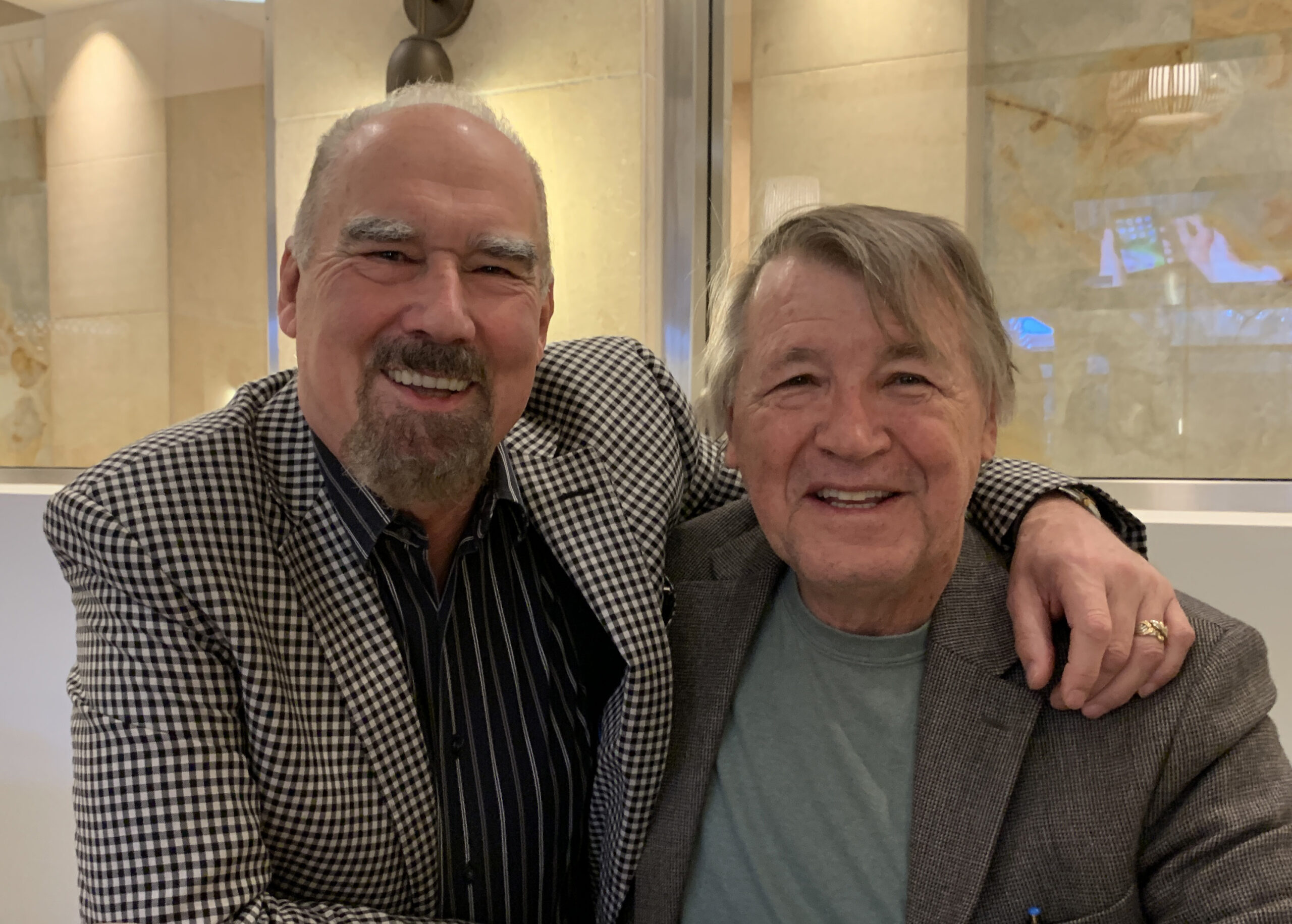 Me and friend, the late Stephen Sinatra MD
So what is it this time?
Well, let me start with a story in the press. It concerns a man in his late 50s, who was training to be a Catholic Deacon.¹
He was repeatedly found in a stupor, over quite a number of years. Coupled with this was unsteadiness. He would sometimes stumble and fall. It looked to onlookers as if he was drunk! In truth he drank a little and occasionally, but nowhere near enough to be inebriated.
What was happening?
On one occasion the wife came home to find her husband on the front steps in a stupor.
On another night, when he returned from walking their dog, he seemed unsteady and in a “trancelike state,” the wife said. He told her he had fallen because his shoes were too big.
These zombielike spells became more frequent, coming on suddenly and usually in the evening. The wife began wondering if he was developing dementia; very unusual at his age but by no means unheard of. She saw a therapist to learn how to cope.
He went to his doctor, who attributed the problem to dehydration! Later, after he drove the wrong way down a local parkway, his wife insisted he seek additional medical care. A neurologist suspected seizures, but tests didn’t pinpoint a cause.
It was only after stumbling and hit his head on a coffee table that a trip to the emergency room started the process of real discovery.
At the ER, a blood test yielded a startling result: the patient’s ethanol level was 363 milligrams per deciliter, equivalent to a blood alcohol content of .363%, more than four times the legal limit for driving. But he hadn’t been drinking at all! Scheduled to have prostate-reduction surgery in a few days, in preparation, he hadn’t had even a drop of alcohol.
Of course the usual response in this situation is “Ah, a drinker in denial. We know you’ve been boozing. We have the scientific proof. It’s no use you lying!”
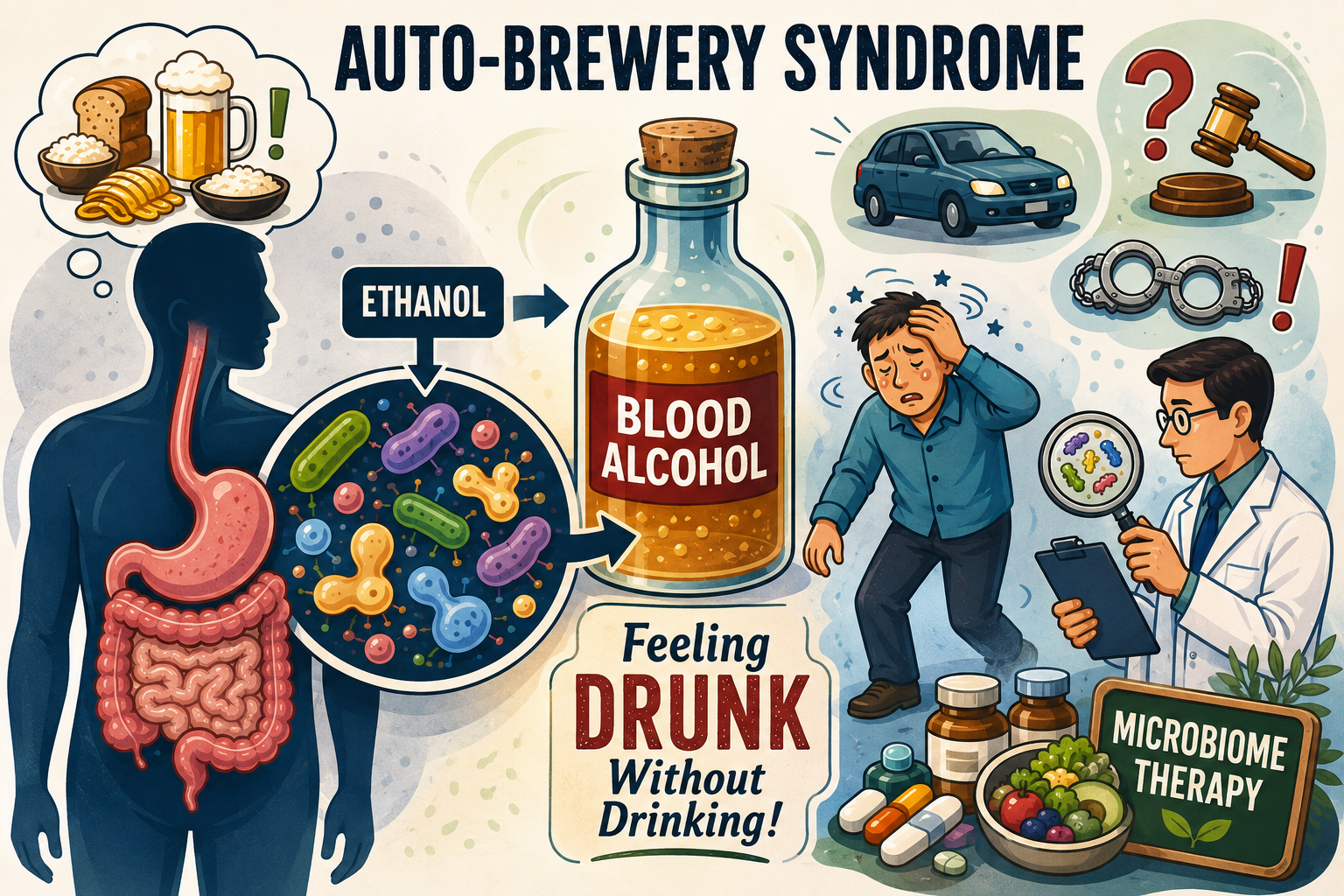
But he was telling the truth: this was a case of so-called auto-brewery syndrome or as I christened it decades ago, an “on-board brewery”. In this condition, Candida albicans (a kind of yeast), food yeasts or intestinal microbes break down food sugars and carbs to produce unusually high levels of ethanol in the gut, leaving people in a drunken state.
They essentially brew their own alcohol right in the gut.
I was once asked (around 1988, I seem to recall) to act as expert witness in defence of a man who had this condition quite obviously. I proved it by giving him a loading dose of sugar and taking repeat bloods. The man’s blood alcohol went up and up and up, while sitting in front of me and drinking nothing but water.
Unfortunately, the court wouldn’t listen and followed the police line: he was drunk while in charge of a vehicle, with an illegal blood alcohol level, obviously due to imbibition. His protests he had not been drinking were simply ignored because the charge was simply “illegal blood alcohol level”, without any emphasis on where it came from.
That was the state of the science then, and even now. It’s rare to encounter a doctor or health worker who know about this condition, much less understands the mechanism.
However, today we have a nonprofit, Auto-Brewery Syndrome Advocacy and Research. The Deacon and his wife were connected with Bernd Schnabl, a gastroenterologist at the University of California at San Diego, who was conducting a study of people with signs of this condition. He enrolled.
He met with Prasanna Wickremesinghe, a gastroenterologist at Richmond University Medical Center in New York City, who with colleagues published a case study in 2019 about auto-brewery syndrome.²
To determine whether this was the problem, “Dr. Wick,” as patients call him, conducted a glucose challenge test, exactly as I had done nearly 40 years ago. Then, Wickremesinghe collected samples from the patient’s digestive tract and found a massive overgrowth of Saccharomyces cerevisiae, or “brewer’s yeast”.
Wickremesinghe prescribed Nystatin, an antifungal medication which I used routinely in my office at the time, and recommended a reduced intake of carbohydrates and alcohol. For several months, the episodes went away.
But the episodes kept recurring. “It’s like flipping a switch,” the patient said. “You’re perfectly normal one minute, and the next minute you’re toast.”
He was put on another antifungal, fluconazole (Diflucan). It seemed to help, but there were still periodic events. It was very worrying. Due to concerns, he was forced to take a leave from his deacon duties, fearing he would zone out while conducting a baptism or wedding. They bought a $1 million liability insurance policy in case his unpredictable behavior left someone injured. He tried acupuncture, coffee enemas and sessions in a sauna. He saw a naturopathic doctor, who prescribed a special probiotic pill for which the Andersons paid $1,500 a month. It didn’t stop the spells.
Fecal Transplant
In this procedure, microbes from the processed feces of screened healthy donors are consumed in oral capsules, which can restore a healthy microbial ecosystem in the recipient’s gut (needs FDA approval, case by case).
Elizabeth Hohmann, an infectious-disease specialist at Mass General Brigham medical center in Boston was contacted. Hohmann had administered hundreds of fecal transplants, mostly to patients with infections of bacteria known as Clostridioides difficile (C. diff). In research studies, she also gave them to people with obesity, liver disease and conditions requiring bone marrow transplants.
However, even she was skeptical of the Deacon’s case. But agreed to talk to Schnabl, the gastroenterologist in San Diego. She learned that when glucose was added to stool samples (out of the body) from this patient and other study participants in a lab bioreactor, ethanol levels in the samples shot up.
No arguing with that. So Hohmann instituted the treatment. It took some time but ultimately the result was a Wow!
I diagnosed Candida for this a lot in the 80s and 90s, because I was looking for it. I did also mention yeasts or Saccharomyces species in my writings of the time. But it has subsequently emerged that other bacteria, including Escherichia coli and Klebsiella pneumoniae, are capable of fermentation reaction too.
The Deacon had taken at least 18 courses of ciprofloxacin and other antibiotics over the years, mostly for prostate inflammation. That’s the usual cause: messing with the patient’s homeostasis. The results aren’t always so horrible but doctors go on blithely prescribing these drugs, as if there were never any consequences. No follow-ups after a certain minimum time on complex antibiotics!
For this patient, the story ended well. But I know from bitter experience that for most unlucky individuals, they are trapped in a personal hell, because of doctors and “experts” who are too stuck in their ways to consider anything out of the ordinary!
Well, I told ‘em!
Prof.
References:
- https://www.washingtonpost.com/health/2026/07/11/years-hed-be-found-stupor-until-fall-led-surprising-diagnosis/
- Malik F, Wickremesinghe P, Saverimuttu J. Case report and literature review of auto-brewery syndrome: probably an underdiagnosed medical condition. BMJ Open Gastroenterology. 2019;6(1):e000325. doi: 10.1136/bmjgast-2019-000325. PMID: 31423320. PMCID: PMC6688673