
Pretty darn hot, as you have probably read. In France temperatures soared to 110 degrees in parts. That’s nothing to those of us who live in the desert southwest but in Europe almost nobody has air-conditioning! Most supermarkets and top hotels do. Virtually zero in small businesses and the homes.
As a result of the searing heat in France, there have been terrible fatalities. The mortuaries of Paris were full! There are so many deceased, the system was overwhelmed. They had to send corpses to faraway cities, like Chartres, 50 miles away, for storage.
Nobody knows what the final figures of excess death will be (it will take weeks, maybe even months, to investigate and calculate). But it’s already apparent that the toll exacted by the intense, unrelenting extreme temperatures was terrible, chiefly among over-65s who died at home and alone.
Public Health France said there were more than 1,200 deaths last Wednesday, when France registered its hottest day EVER, breaking a record that had been set only the previous day! By way of comparison, the pre-heat wave death rate in April and May was around 900 to 1,000 per day, it said.
But there is another sad aspect to this situation. In 2003 France had a similar scorching episode, with record temperature highs and 15,000 resultant deaths, provoking a national reckoning about care of older people, who were particularly hard-hit.
What happened is that the people (not the government bureaucrats, of course) rallied together and responded. It was a kind of “movement” in which everyday folks began to think about their neighbors, to check on them regularly, to see they were drinking enough water and being looked after.
Sweet!
But the lessons have been forgotten, apparently. According to Véronique Bertrand, a Paris funeral director, “With the passing years, we’ve perhaps forgotten that it could happen again and that things would even perhaps be worse.”
“I think people absolutely need to wake up, that solidarity needs to come back… with people thinking about their neighbors, of those around them who live alone,” she said.
Since the 2003 event, France has introduced one of the world’s most sophisticated heat-alert systems, with early warnings, public cooling centers, welfare checks on vulnerable people and mandatory heat plans for care homes. These measures have undoubtedly saved lives, but heat remains a major public-health threat. Between 2014 and 2023, researchers estimated 37,825 heat-related deaths in France alone, Europe’s largest country.
Overall, France’s experience demonstrates that heat is now among our deadliest natural hazards. Even with improved emergency planning, rising temperatures continue to produce thousands of preventable deaths, particularly among the elderly.
Low Salt Diets
Those of you who have been with me for years will know I write from time to time about the very obvious association between low-salt diets and heat deaths. Salt restriction may be an overlooked vulnerability in extreme heat, especially among older adults, diuretic users, and people drinking large volumes of plain water. It leads to hyponatremia, meaning low blood sodium, which you would think from medical rantings about salt was a good thing. Not!
Hyponatremia occurs because high temperatures induce sweating, which depletes sodium, while concurrent excessive intake of plain water dilutes the remaining sodium in the blood.
Low salt diets are dangerous and are handed out indiscriminately, without adequate advice. [Ooops, sorry. Did it look like I was implying most doctors are gravely ignorant of nutritional issues?]
In 2022, a Swedish nationwide study, found hospitalization for hyponatremia rose sharply with temperature; future warming was predicted to increase cases further.¹
A newer JAMA Network Open 2024 paper found urban heat was associated with increased hyponatremia burden, especially in older people and women.²
There is also a 2006 direct experimental paper: “Heat stress responses in men after ingestion of a low-sodium diet,” using only 580 mg sodium/day, showing low-sodium intake changes physiological response to heat stress. There is English on the page, promise!³
I soon noticed, after moving to Las Vegas, that in the extreme heat episodes of the south-western deserts, people on low-salt diets were dropping like flies. I still seem to be the only person making a fuss about this! The honest answer is: the physiology is well-supported, the heat–hyponatremia association has been published. Everyone needs to be on guard, given the current fad for salt restriction.
Don’t just drink water, you need electrolytes too!
What About Vivien and Me? Did We Fry?
Thankfully not. We went to England, about 500 miles to the north! Definitely cooler. We visited family, which was nice, and ultimately found ourselves in the ancient medieval city of Lincoln, which was really nice! All the Mumbys come from within 30 miles of the city, including the hordes in my Dad’s family!
We toiled up the well-named Steep Hill to the cathedral, past ancient buildings, like the “Jew’s House” of 1170 (now a restaurant), to the cathedral, with its warm honey-colors stone. High up on a hill, it was preserved from some of the worst of acid-rain erosion which characterizes most medieval European buildings, and I thought it looked glorious.

For over 237 years Lincoln cathedral was the tallest building in the world, when its timber and lead central spire reached 525 ft (160 metres). It was the first edifice to surpass the Great Pyramid of Giza, which had held the record for nearly 4,000 years!
Sadly, when the great spire was blown down in a storm in 1548, it lost the title.
 Model of Lincoln Cathedral as it once was, with spires
But what interested me most was the Magna Carta. You probably know the historical importance of this document which was drafted by King John and his barons, at Runnymede island, on the River Thames, in 1215. It limited the powers of the king and established the important principle that even the king is not above the law, which is universal, even today.
The most celebrated is Clause 39, which states:
“No free man shall be seized or imprisoned… except by the lawful judgment of his equals or by the law of the land.”
This was revolutionary because it declared that even the king could not imprison people arbitrarily.
Closely related is Clause 40:
“To no one will we sell, to no one deny or delay, right or justice.”
Together, these principles established what later became known as due process of law.
Several copies of the 1215 document were made, sealed with the king’s seal, and sent to various cities in England, including Lincoln. The only surviving copies of this great charter are now the one in Lincoln castle, one in Salisbury cathedral and the British Library (2 copies).
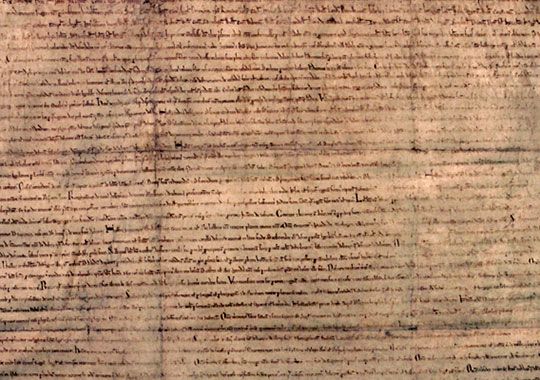 The Magna Carta near is unreadable but I don’t speak Latin anyway!
It was awesome to behold this ancient manuscript, from just a few inches away, even though hermetically sealed behind glass in a darkened room!
Well, that’s all from Europe. I hope to be back in Vegas in just a few weeks.
Meantime, stay positive and stay healthy (don’t go near doctors!)
To Your Good Health,

Prof. Keith Scott-Mumby
The Official Alternative Doctor
Source Article:
https://www.medpagetoday.com/publichealthpolicy/environmentalhealth/121970
References:
-
- Current and Future Burdens of Heat-Related Hyponatremia: A Nationwide Register-Based Study. J Clin Endocrinol Metab. 2022 May 17;107(6):e2388-e2393. doi: 10.1210/clinem/dgac103
- Prpic M, Hoffmann C, Bauer W, Hoffmann P, Kappert K. Urban Heat and Burden of Hyponatremia. JAMA Netw Open. 2024;7(12):e2450280. doi:10.1001/jamanetworkopen.2024.50280
- https://www.czytelniamedyczna.pl/822%2Cheat-stress-responses-in-men-after-ingestion-of-a-lowsodium-diet.html