This is part 2 of a major article which started last week. If you haven’t read it yet, I suggest you do that first. Go here…
Measuring Biological Aging
There is no single dial on the body that reads “You are 47.3 years old, biologically speaking.” Instead, we triangulate. We infer. We listen to multiple systems at once and look for points of convergence.
That said, we can now go far beyond the guesswork of old.
The first thing to understand is that biological age is not one thing. It is a composite signal emerging from many interacting systems. Any attempt to measure it with a single marker is guaranteed to be incomplete. Accuracy comes not from perfection, but from overlap—when different measures, drawn from different layers of biology, begin to tell the same story.
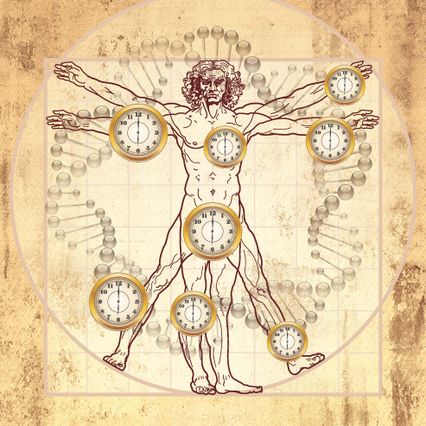
Leonardo da Vinci’s Vitruvian Man re-imagined!
One of the most powerful approaches currently in use is epigenetic aging. This is based on DNA methylation patterns—chemical tags that sit on DNA and regulate which genes are turned on or off. These patterns change predictably with biological aging, but crucially, they change faster or slower depending on lifestyle, stress, illness, trauma, and environment.
Epigenetic clocks—such as those developed by Steve Horvath and others—compare an individual’s methylation profile to large population datasets to estimate biological age. When someone’s epigenetic age is higher than their calendar age, it correlates strongly with increased disease risk, frailty, and mortality. When it is lower, it correlates with resilience and longevity.
What makes epigenetic clocks compelling is not that they measure time, but that they measure cellular memory. They capture the imprint of lived experience on gene regulation. This is why they respond to interventions—diet, exercise, stress reduction, sleep, even psychosocial changes. The clock can slow. Sometimes it ticks backward.
Another major axis of measurement involves inflammatory burden. Chronic, low-grade inflammation—often called inflammaging—is one of the strongest drivers of biological aging. Markers such as C-reactive protein, interleukin-6, tumor necrosis factor-alpha, fibrinogen, and white blood cell ratios reveal whether the immune system is in a state of calm vigilance or chronic activation.
An immune system stuck in alert mode ages tissues faster. It degrades collagen, damages blood vessels, disrupts insulin signaling, and interferes with repair. Elevated inflammatory markers often predict biological age more accurately than calendar age ever could.
The importance of the immune system is such that over 35 years ago, I wrote: “We live just as long as our immune systems will allow us”.
That came from the observation of AIDS victims, whose immune systems collapsed. They aged frighteningly fast, often dying within months but suddenly looking decades older.
Then there is metabolic age, which quietly governs how efficiently the body turns fuel into life. Measures like fasting insulin, insulin sensitivity (HOMA-IR), triglyceride-to-HDL ratios, HbA1c, lactate thresholds, and resting metabolic flexibility give insight into how “old” the metabolic machinery is behaving.
Cardiovascular measures also serve as remarkably accurate proxies for biological age. Arterial stiffness, pulse wave velocity, blood pressure variability, endothelial function, and heart rate variability reflect the condition of both blood vessels and the autonomic nervous system. A heart that recovers quickly, varies its rhythm fluidly, and responds gracefully to demand is biologically younger than one that plods, stiffens, and overreacts.
Heart rate variability, in particular, is fascinating because it bridges physiology and perception. It reflects vagal tone, emotional regulation, and nervous system flexibility. High variability correlates with youthfulness, resilience, and longevity. Low variability correlates with accelerated aging, chronic stress, and disease risk. The heart, it turns out, is an excellent historian.
There is also functional age, which medicine is slowly rediscovering after decades of obsession with lab values alone. Grip strength, gait speed, balance, reaction time, VO? max, recovery from exertion—these are not cosmetic metrics. They integrate muscle strength, nerve tone, cardiovascular vitality, and metabolic health into real-world performance.
How fast do you get tired? How fast do you recover? How confidently does your body move through space? These questions often predict mortality better than sophisticated imaging.
At the cellular level, markers of repair capacity matter enormously. Telomere length was once hyped as the aging marker, and while it is no longer considered enough on its own, it still tells an important part of the story. Telomeres shorten as cells divide, but their rate of shortening varies dramatically based on stress, inflammation, oxidative load, and lifestyle. Short telomeres are not destiny, but they do signal accumulated strain.
Equally important—but less commonly measured—are markers of mitochondrial health. ATP production efficiency, oxidative stress levels, mitochondrial DNA integrity, and metabolic byproducts reveal how energetically “young” cells are. Aging, at its core, is often an energy problem before it is a structural one.
Cognitive and neurological measures also belong in any serious assessment of biological age. Processing speed, working memory, sensory acuity, sleep architecture, and circadian rhythm robustness all decline with biological aging—but not inevitably with time. Brains, like bodies, age fastest under chronic threat and slowest under curiosity, safety, and engagement.
Here is the key point that often gets missed: no single test gives you biological age. Accuracy emerges from accumulated pattern recognition across systems. When epigenetics, inflammation, metabolism, cardiovascular function, and performance all point in the same direction, you are no longer guessing. You are listening to the body in stereo.
And there is an even deeper layer—one medicine is only beginning to acknowledge. Biological age is inseparable from nervous system state. A body that feels perpetually unsafe (high active stress) ages faster, regardless of diet or supplements. A body allowed to regularly enter deep parasympathetic repair modes slows aging across every measurable domain.
This is why two people with identical lab panels can age differently over time. One heals. One doesn’t. The difference is not compliance—it is coherence.
So how do we accurately measure biological age?
We triangulate it like a constellation. We track trends over time rather than relying on single numbers. We investigate whether the organism is becoming more resilient or more brittle, more adaptable or more reactive, more coherent or more fragmented.
Back to our first metaphor, let’s say calendar age tells you how many laps around the sun you’ve completed. Biological age tells you how intact the vehicle is—and whether it’s learning how to repair itself while still moving!
Identifying reliable biomarkers of aging is a current major goal in geroscience. Things have moved very fast in the last 2 decades!
Testing Biological Age
The most widely validated and scientifically accepted biological age tests are epigenetic clocks. These look at chemical tags on your DNA — especially DNA methylation — that change in very predictable ways as your body ages.
Unlike genetic sequences (which are fixed in your DNA), methylation patterns shift depending on life history: lifestyle, stress, diet, pollution, inflammation, and even social experiences leave detectable scars on your epigenome. By reading these patterns across hundreds to thousands of sites in the genome, algorithms can estimate your “biological age” relative to a population average.
The famous Horvath clock, developed by Dr. Steve Horvath, analyzes over 350 CpG sites (regions of DNA where methyl groups attach) and has a median error of only a few years compared to chronological age — remarkably precise for a biological process.
Commercial tests like TruDiagnostic’s TruAge and myDNAge are based on this kind of analysis — you send a blood or saliva sample, and they return an estimate of your biological age along with personalized insights.
Researchers have also developed variations like PhenoAge, GrimAge, and the DunedinPACE clock — each tuned to different aspects of aging (disease risk, mortality prediction, aging pace, etc.).
Telomere Length Tests. Telomeres are protective caps at the ends of chromosomes that shorten with each cell division. Early aging research popularized telomere length as a proxy for biological age. Today, we know telomere tests are noisy and less predictive than epigenetic clocks — telomeres can vary widely between individuals and even fluctuate with temporary stressors — but they still supply useful context when interpreted alongside other biomarkers.
Companies such as Life Length specialize in telomere diagnostic services, often combining telomere length with telomerase activity (the enzyme that rebuilds telomeres) for a richer picture.
Blood-Based Biomarker Age and Machine Learning Models. Some commercial and research programs don’t rely solely on DNA at all. Instead, they analyze panels of blood biomarkers and use machine learning (AI) to derive an age estimate based on how your physiology compares to large datasets.
These can include patterns across:
• Inflammatory markers like C-reactive protein
• Metabolic markers like glucose and triglycerides
• Hormones, cytokines, and more
Such tests — sometimes called proteomic or deep aging clocks — can use hundreds of circulating proteins and cell counts to estimate biological age and even predict disease risk before symptoms appear.
Composite Age Scores with Frailty and Functional Metrics
Some approaches combine clinical measurements (like blood pressure, glucose regulation, body composition) with functional performance (strength, gait speed, cognitive tests) into composite indices that estimate biological age.
This is less molecular but very practical for assessing overall physiological reserve and real-world function.
Emerging and Multimodal Tests
Cutting-edge methods blend multiple data layers — epigenetics + proteomics + metabolomics + phenotypic signs — often refined by with AI models to give an age estimation beyond what any single marker can offer.
None of these tests claim to measure a literal “number of years lived,” because that wouldn’t be biological. Instead, they measure patterns that correlate with:
• Cellular maintenance capacity
• Immune function
• Metabolic resilience
• Inflammatory burden
• Epigenetic change rates
• Disease susceptibility trajectories
In short, they measure how your body is functioning relative to its chronological peers, which is far more meaningful for health outcomes than the number of candles on your birthday cake.
Accuracy and Real World Use
Epigenetic clocks currently represent the most scientifically robust measure of biological age available — but it’s not perfect. Different clocks can give slightly different ages, and results are influenced by which tissues are sampled (blood vs saliva, etc.), the model used, and technical variability in lab processes (no two lab give identical results).
Many experts caution that these tests are predictive tools, not definitive statements of destiny. But compared to traditional age markers like telomeres, they are far more predictive of disease risk and mortality patterns.
Poetically speaking, what all these tests do is read the echo of your life in your biology. They read the impact left by nutrition, trauma, adaptation, stress management, repair capacity, and systemic resilience. They capture your physiological biography rather than your chronological biography.
All of them, in their own way, try to answer one question: Is your biology older, younger, or on track — and what does that mean for your future health?
To Your Good Health, Prof. Keith Scott-Mumby
The Official Alternative Doctor