
Mounting observational evidence links ultraprocessed food with heart disease, cancer and death.
Science has begun to wake up to the fact that junk food is bad for health, a message I was writing a full 45 years ago!
Of course the idea is being fought furiously by Big Food and Big Pharma, who don’t want anyone to recognize the connection between eating crappie foods and falling into the medical system as a permanent victim, to be milked financially.
TV drug ads repeatedly show people with serious conditions, on dangerous meds, eating junk and smiling. It’s a clear subliminal message that what you eat is not important; those holistic boobies are trying to subvert your diet but they are wrong.
I’m reporting here on a vast study carried out by a Chinese team, in which they analyzed the diets and health histories of 8.8 million people worldwide, showing clearly ultraprocessed foods cause harm. But the shills and apologists for the food industry made sure the phrase “It’s not been proven that avoiding ultraprocessed foods is beneficial to health,” was included.
[https://www.medpagetoday.com/primarycare/dietnutrition/123118]
Up to that point their specious (clever, self-serving) arguments centered around the fact that “there is no definition of what ultraprocessed means…” (therefore it cannot be a problem kind of thinking).
True, there is as yet no formal definition of ultraprocessed food, but it is commonly accepted to indicate products that undergo extensive industrial processing and contain multiple additives. These foods tend to have lower nutritional value and high energy, which delays the feeling of fullness and may increase eating rate and overall food intake.
By one estimate, ultraprocessed foods account for more than half the calories consumed in the U.S. diet. In fact 57.9% of Americans’ calorie intake came from ultraprocessed foods in a nationally representative study published in BMJ Open in 2016, using dietary data from 2009–2010 (in 2026 it will be far worse).
Today I can report that HHS Secretary Robert F. Kennedy Jr., prioritizing nutrition in his “Make America Healthy Again” agenda, has had the FDA complete its work on the federal government’s first-ever definition of ultraprocessed food; and it has reportedly submitted the definition to the White House for further review.
I have not seen this proposed definition.
The study I took interest in was a meta-analysis covering 51 prospective cohort studies and over 8.8 million participants, in which there emerged a clear dose-dependent link between ultraprocessed food consumption and bad health outcomes, such as significantly higher risks of cardiovascular events, cancer, mortality, and metabolic syndrome (overweight, obesity and diabetes, sometimes called diabesity).
Dose-dependent means the more you eat of ultraprocessed foods, the worse your health outcomes. In fact the researchers were able to quantify it quite neatly. For each 100 g of these foods eaten daily was associated with significantly higher risks of:
• Cardiovascular events (up by 14%)
• Cancer (up by 4%)
• All-cause mortality (up by 3%)
• Metabolic syndrome (MetS)/diabetes (up by 2%)
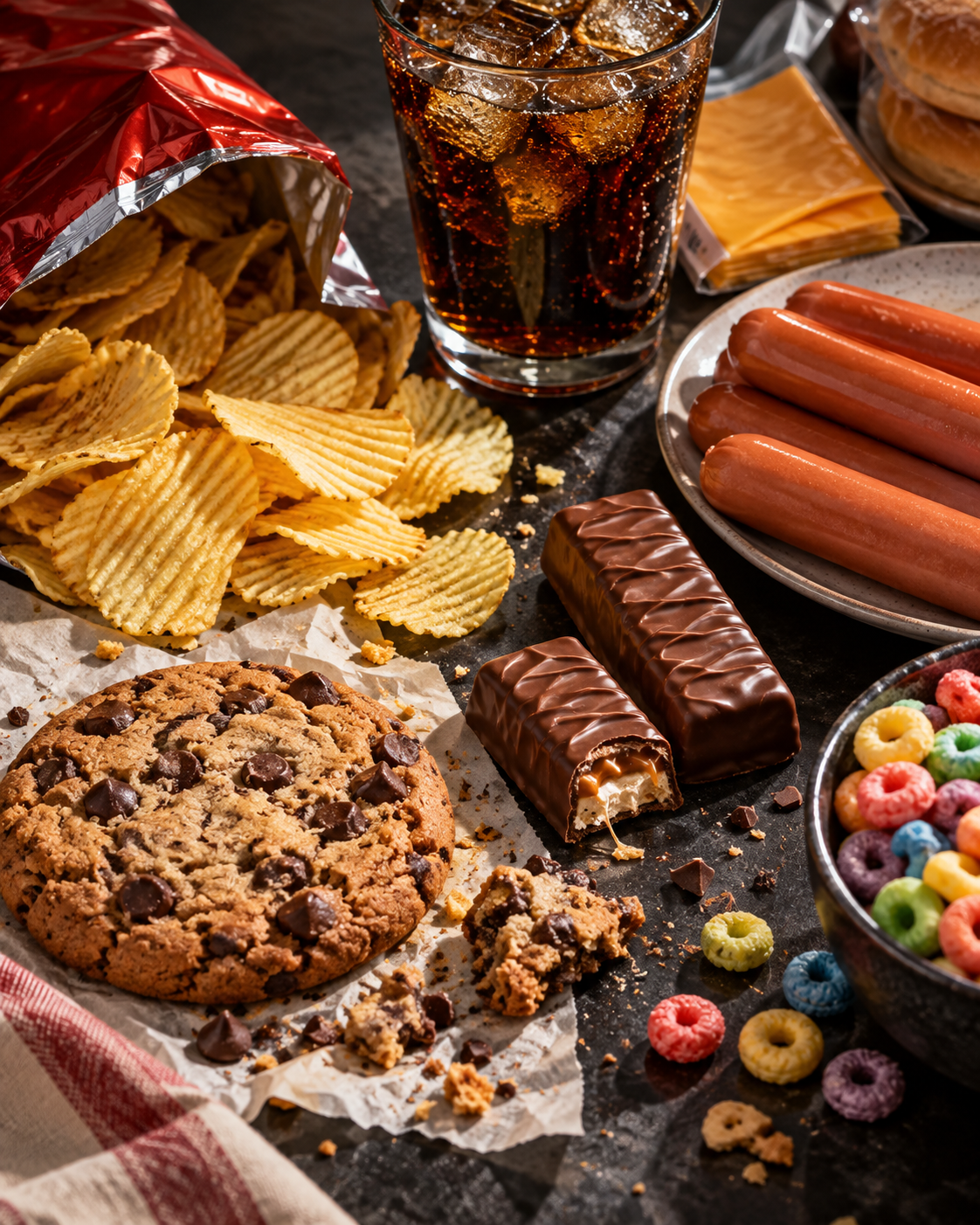
That 100 g can represent a large store-bought cookie, about four servings of potato chips, two 50g bars of chocolate-coated candy bars, or roughly two hot dogs. So if you consume 300 g of processed foods daily, that means cardiovascular events up by 42%, cancer up by 12%, etc.
The research group, led by Xiao Liu, MD, PhD, of Duke-NUS Medical School in Singapore, and Sun Yat-Sen Memorial Hospital, Sun Yat-sen University in Guangzhou, China, in Family Medicine and Community Health, concluded that, “Consuming UPFs [ultraprocessed foods] was associated with higher risks of multiple chronic diseases and all-cause mortality with low or moderate evidence. Reducing dietary intake of UPFs may therefore be relevant for chronic disease prevention.”
“[P]rimary care practitioners may advise gradual reduction of UPFs intake towards approximately 10%-20% of total daily energy intake, while considering which UPF subtypes are most strongly associated with adverse outcomes. Replacing UPFs with minimally processed alternatives, rather than restriction alone, may provide a more sustainable and patient-centered approach,” the authors suggested.
Why not reduce it to 0% of total energy intake?
The pharma-based journal reporting the story (MedPage TODAY) was tricky and manipulative in its wording and announced that, “While there are plenty of studies indicating that diets high in ultraprocessed foods are associated with health harms, the idea that these foods directly cause chronic illness is unproven…”
Another apologist who tried to negate the findings and muddy the waters was statistician Adam Jacobs, PhD, MSc, from Ergomed in Guildford, England.
“People who consume low amounts of UPF are generally more affluent than those who consume more UPF, and we know that poverty is one of the strongest predictors of poor health. So it is possible that UPF consumption is simply a marker for poverty, rather than being harmful per se.”
This is just specious reasoning: the reason poverty is so bad for health is that individuals in that band cannot eat good food, so they eat mainly junk (UPFs). It supports the findings and does not negate them.
“There are other possible confounding variables to consider, to do with lifestyle,” continues Jacobs. “For example, people doing shift work or with particularly stressful lives may eat more UPF. Few studies adjusted for such factors.”
Yes, Jacobs, therefore your speculation is worthless. Let’s stick to FACTS, shall we? Like the FACTS that have emerged from this very timely and welcome study.
There are also major issues with observational studies trying to measure food intake. Consumption of ultraprocessed foods had been assessed by food frequency questionnaires, 24-hour recalls, or dietary history in studies included in the meta-analysis.
“Measuring food intake is notoriously difficult, as people are often not very good at remembering what they ate,” agreed Gunter Kuhnle, PhD, of the University of Reading in England, in a separate Science Media Centre entry. “Estimating UPF intake from these data is even more difficult for several reasons,” he continued, citing an ambiguous definition of ultraprocessed food and unclear food categories.
“There is little evidence that avoiding UPF is beneficial to health,” Kuhnle stressed. Well, not any more.
The meta-analysis covered studies with participant ages ranging from 23.9 to 77 years on average; 46.4% were men.
Consumption of UPFs was significantly associated with cardiovascular events, cancer, obesity/overweight, MetS/diabetes, depression/anxiety, digestive diseases, and all-cause mortality.
However, the evidence was deemed low-certainty for all of these except the obesity/overweight endpoint, for which the evidence was considered only moderate-certainty.

We need more studies till we get beyond the point where apologists can argue that evidence is weak, I agree. Personally I need no scientific studies whatever to conclude that food which is not food has little nutritional benefit!
“Future studies should adopt harmonized and subtype-specific UPF exposure metrics, improve dietary assessment methods, and clarify clinically meaningful intake thresholds across diverse populations,” Liu and colleagues urged.
Disclosures
This work was supported by the Natural Science Foundation of China; Natural Science Foundation in Jiangxi Province; and the Jiangxi Province Thousands of Plans.
Liu and co-authors declared no conflicts.
Jacobs said he had no conflicts.
Kuhnle is a former member of the U.K. Committee on Toxicity of Chemicals in Food, Consumer Products, and the Environment; a current member of the Advisory Committee on Novel Foods and Processes; director of a facility that provides analytical services to academic and commercial clients; has previously received research funding from Mars for work on flavanols and consultancy payments from RSM UK and EQT, paid to the University of Reading. Not one to want to antagonize his donors therefore!
I think I can sum this up by saying we all know that UPFs are counter-nutritional to the degree of being harmful but that current science is expending an awful lot of time and energy trying to prevent this simple fact from interfering with the profits of the food industry (to the ultimate benefit of Big Pharma)!

Prof. Keith Scott-Mumby
The Official Alternative Doctor
Source Reference: Liu X, et al “Ultra-processed food consumption and risk of multiple chronic diseases among 8,819,894 adults from 51 prospective cohorts: a dose-response meta-analysis” Fam Med Com Health 2026; DOI: 10.1136/ fmch-2026-003925.
Medpage TODAY article: https://www.medpagetoday.com/primarycare/dietnutrition/123118