
Friedrich Nietzsche. The original German is:
Was mich nicht umbringt, macht mich stärker.
Literally: “What does not kill me makes me stronger.”
Health is not created by eliminating every difficulty from life. The body is not a porcelain ornament that survives best when nothing disturbs it. It is an adaptive organism, designed to be challenged, to respond, to repair and—within limits—to return stronger.
This is the essence of hormesis: a stressor that is harmful in a large or prolonged dose can stimulate beneficial adaptation when delivered in a small, controlled, intermittent dose. The response is commonly represented by a J-shaped or inverted U-shaped curve. Too little challenge leads to stagnation; an appropriate amount encourages adaptation; too much causes injury.
The stressor is not necessarily “good” in itself. What is beneficial is the organism’s resistance response to it.
Exercise provides the clearest example. A hard walk or session with weights temporarily disturbs the body. Muscle fibers experience microscopic damage; ATP demand rises; reactive oxygen species increase; calcium balance changes; inflammatory signals are released. Yet those disturbances activate repair, mitochondrial biogenesis, antioxidant defenses, glucose transport, protein synthesis and tissue remodeling. Provided there is sufficient recovery, the person becomes better equipped to withstand the next challenge.
The exercise did not make the body stronger during the stressful part. The body became stronger while recovering from it.
This gives us the basic formula:
Challenge + adequate recovery = adaptation.
Challenge without recovery = breakdown.
Recovery without challenge = gradual decline.
So, What Is Hormesis?
I first wrote about this little-known effect in 1999 in my book VIRTUAL MEDICINE, which is now expanded and published as MEDICINE BEYOND.
Hormesis (from Greek hórm?sis, “rapid motion, eagerness,” from ancient Greek hormáein “to set in motion, impel, urge on”) is the term for generally favorable biological responses to very low-level exposures to toxins and other stressors. It’s a biological version of the old saw: That which does not kill me makes me stronger. See graph:
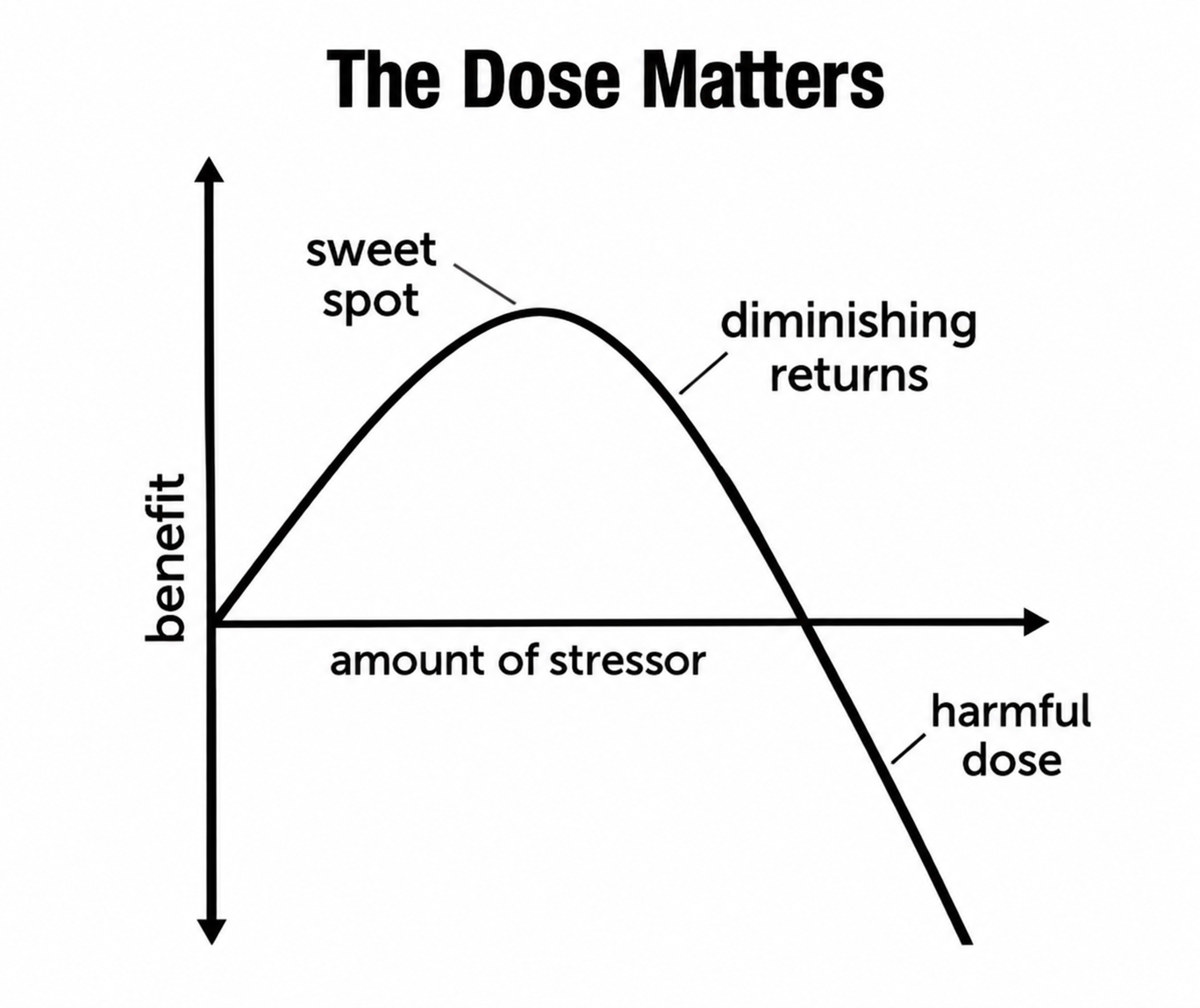
Increasing doses stimulate at first and then steadily suppress (inhibit)
Paracelsus was there first, working with micro-doses of noxious agents and obtaining significant therapeutic results.
One of the valuable areas where the concept of hormesis has been explored extensively with respect to its applicability is aging. Since the basic survival capacity of any biological system depends on its homeodynamic (homeostatic) ability, biogerontologists proposed that exposing cells and organisms to mild stress should result in the adaptive or hormetic response with various biological benefits. This idea has now gathered a large body of supportive evidence showing that repetitive mild stress exposure has anti-aging effects12.
In 1998, Edward J. Calabrese and Linda A. Baldwin at the Department of Environmental Health Sciences, School of Public Health, University of Massachusetts, published a survey of publications, judging their worth and validity, and found over 4,000 relevant research papers. Their analysis suggests that hormesis is a reproducible and relatively common biological phenomenon, pertinent to many living species and a wide variety of tissue insults, including radiation, temperature extremes, and chemical toxins.
Strychnine And The Old-Fashioned Tonic
An example would be strychnine, a deadly poison, which was once used medicinally in minute doses as a stimulant and included in various “tonics.” It even appeared in early athletic performance experiments. Thomas Hicks, winner of the notorious 1904 Olympic marathon, was given strychnine and brandy during the race—a performance-enhancement program that makes modern sports nutrition look positively timid.
Strychnine blocks glycine receptors, particularly in the spinal cord and brainstem. Glycine normally restrains motor-neuron activity. Remove that inhibition and the nervous system becomes violently excitable, producing muscle spasms, convulsions, respiratory failure and potentially death. The difference between an apparently stimulating dose and a dangerous one is far too narrow to make strychnine a sensible modern hormetic. It is a fine historical illustration of dose-dependent effects, but a dreadful lifestyle recommendation.
Hormesis does not give us license to consume tiny quantities of every poison. Some agents cause cumulative damage, mutations or cancer without any established beneficial range. There is no sound reason to seek hormesis from lead, mercury, asbestos, tobacco smoke or ionizing radiation. We already possess much safer ways of activating our cellular defence systems.
Why Stress Can Strengthen Us
Mild stress activates a network of ancient survival mechanisms. These include heat-shock proteins, antioxidant enzymes, DNA-repair systems, autophagy, mitochondrial renewal, immune surveillance and metabolic switching.
Autophagy is cellular housekeeping: damaged proteins and worn-out components are identified, dismantled and recycled. Exercise and temporary food deprivation can stimulate this process, although human autophagy is difficult to measure directly and extravagant claims about the exact hour when it “switches on” should be treated cautiously.
Another response is mitochondrial biogenesis—the production and improvement of the cellular machinery that generates energy. Cells exposed to manageable energy demands receive a message: We need more capacity. Muscle responds similarly to resistance. Bones respond to loading by retaining or building structure. The cardiovascular system responds to increased demand by improving delivery.
This is not confined to the body. The nervous system also needs appropriate challenge. Learning, novelty, coordination, social engagement and solving difficult problems encourage the brain to maintain its networks. A life in which nothing surprises, stretches or occasionally frustrates us may be psychologically comfortable but biologically impoverished.
The significant word is intermittent. A brief stress followed by safety and restoration can be strengthening. Continuous stress is something else. Chronic anxiety, sleep deprivation, loneliness, overwork, unremitting inflammation and relentless strenuous exercise do not reliably produce hormesis. They produce allostatic overload—the cost of having the emergency machinery switched on for too long.
The body needs punctuation. Stress is the exclamation mark; recovery is the full stop.
The Most Useful Hormetic Stressor: Muscular Work
Resistance training is probably the most valuable controlled stressor for an older adult. Muscles need to be given a reason to remain. If they are never required to push, pull, carry, rise, grip or stabilize, the body quite economically dismantles what it considers unnecessary tissue.
The exercise must be challenging enough that the final repetitions require genuine effort, while remaining technically safe. That might mean weights, resistance bands, machines, sit-to-stands, wall push-ups, stair climbing or carrying groceries. The ideal method is the one that can be progressively increased without provoking injury.
Large systematic reviews of trials in older adults show that resistance training improves strength, function and, to varying degrees, muscle mass. Even very elderly people can improve.
Brief bursts of vigorous activity can add another useful challenge. These have acquired the rather charming name exercise snacks: perhaps 30–60 seconds of brisk stair climbing, fast walking uphill or rapid cycling, repeated a few times during the day. Observational evidence associates small amounts of vigorous intermittent lifestyle activity with lower cardiovascular and overall mortality, although association does not prove that the brief bursts alone caused the benefit.
For an 81-year-old, “vigorous” should be defined personally. It means sufficiently demanding to produce heavier breathing, not an invitation to discover whether the paramedics are having a quiet afternoon. Anyone with unstable cardiovascular symptoms, unexplained breathlessness, fainting, serious arrhythmia or uncontrolled blood pressure should be assessed before experimenting with vigorous exertion.
Heat: An Ancient Stress Signal
Heat exposure is another plausible hormetic practice. Sauna temporarily raises skin and core temperature, increases heart rate and redistributes blood flow. Cells respond by increasing heat-shock proteins, which help stabilize and repair other proteins. Repeated exposure may also improve vascular function and heat tolerance.
Finnish observational studies have found that more frequent sauna use is associated with lower cardiovascular and all-cause mortality, and possibly lower dementia risk. These are impressive associations, but they do not prove that sauna alone caused the benefits. Sauna users may differ in exercise, income, social connection, diet and general health. Reviews nevertheless conclude that Finnish sauna bathing has one of the more substantial bodies of evidence among passive heat practices.
A practical approach might be 10–20 minutes at a tolerable temperature, perhaps two or three times weekly, leaving immediately if dizziness, nausea, chest discomfort or unusual weakness develops. Hydration matters. Alcohol and sauna are an especially foolish partnership because of hypotension and arrhythmia risk. People with unstable heart disease, severe aortic stenosis, recurrent fainting or poorly controlled blood pressure need individual medical advice.
A hot bath may provide a gentler alternative. It does not reproduce every feature of sauna, but it can supply a modest thermal challenge and may benefit vascular function. Passive heat is especially interesting for people whose mobility limits vigorous exercise, although it should complement movement rather than replace it.
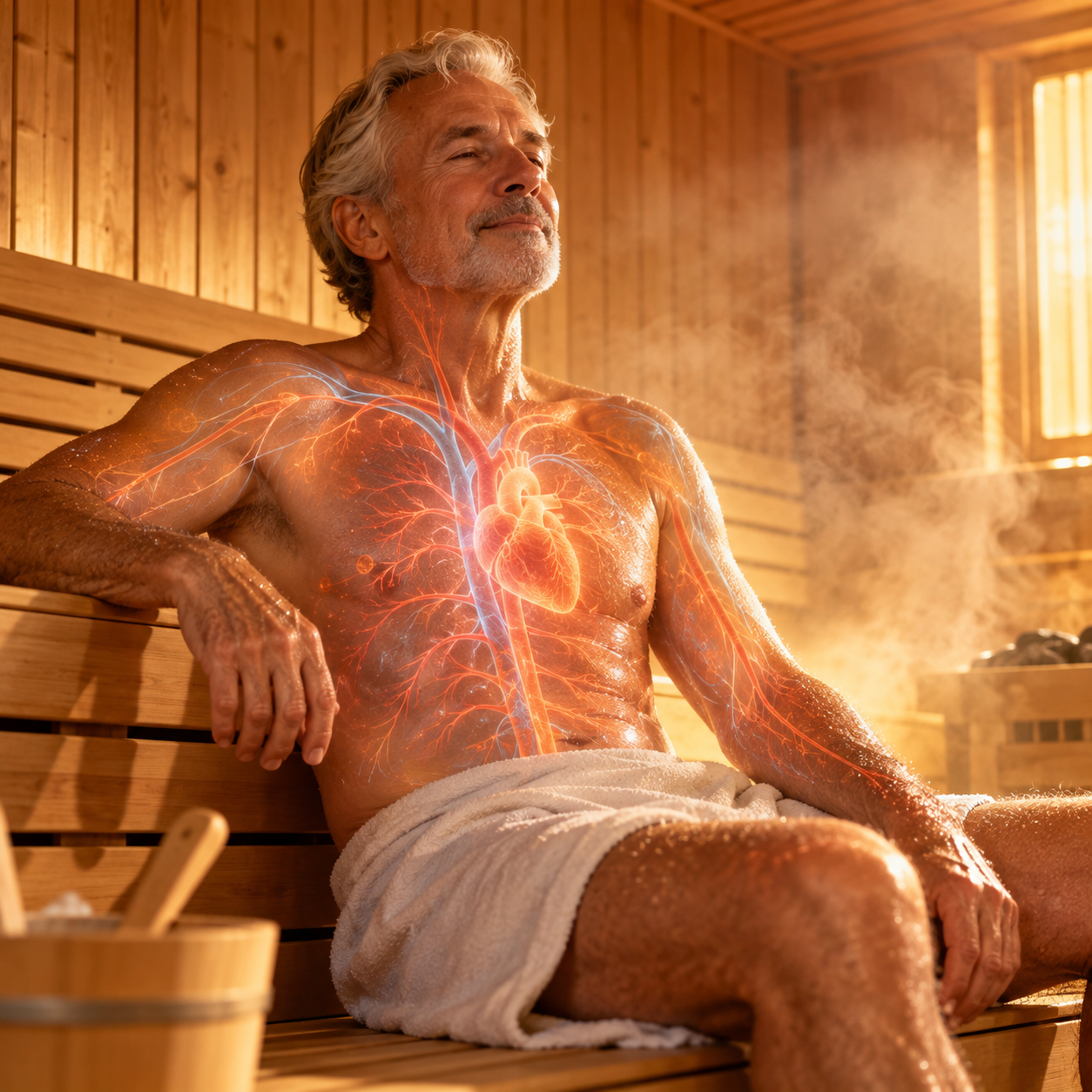
Cold can be a stressor too, however, the evidence is far less triumphant than the evangelists imply. One does not need to sit heroically in a dustbin full of ice!
Finishing a normal shower with 20–30 seconds of cool water, gradually extended if enjoyable and well tolerated, can provide a mild challenge. Cold-water swimming should never be undertaken alone, and sudden immersion is particularly unsuitable for someone with significant heart disease, arrhythmia, uncontrolled hypertension or a history of fainting.
Cold immediately after resistance training may actually be counterproductive when muscle growth is the goal, because suppressing the acute inflammatory and signaling response may reduce part of the adaptation.
Temporary Hunger Rather Than Constant Grazing
Food scarcity was intermittent throughout human evolution. Constant access to calories is comparatively new. Allowing a daily period without food may encourage metabolic flexibility—the ability to move between glucose and fat metabolism—and may improve insulin sensitivity or assist weight control in some people.
A moderate overnight fast of roughly 12 hours is a reasonable starting point: finish dinner at 7:30 p.m. and eat breakfast at 7:30 a.m. Some people may extend this to 13 or 14 hours, preferably by avoiding late-night food rather than sacrificing breakfast and then devouring the kitchen at noon.
Time-restricted eating studies show modest improvements in weight and some metabolic markers, but it is not magic and is not invariably superior to ordinary calorie control. In older adults, the chief concern is protecting muscle. Adequate total protein, resistance training and sufficiently substantial meals are more important than achieving an impressive fasting window. Trials suggest that time-restricted eating can preserve lean tissue when combined with resistance training and adequate nutrition, but frail or underweight people should not treat fasting as a longevity competition.
People taking insulin or sulfonylureas, those with a history of eating disorders, pregnant women, and frail or undernourished individuals need particular caution.
A Hormetic Lifestyle
An excellent week might include two or three strength sessions, several brisk walks, one or two brief vigorous intervals where medically appropriate, and regular balance work. Add sauna or a hot bath a few times weekly, an occasional cool shower, and a consistent overnight period without eating. Include novelty: take a different route, learn something difficult, talk to someone outside your usual circle, lift something moderately heavy, spend time outdoors in imperfect weather.
Then recover deliberately. Eat adequate protein and nourishing food. Sleep deeply. Alternate demanding days with easier ones. Maintain companionship, pleasure and periods of genuine calm.
The goal is not to collect stressors as if competing in the Hormetic Olympics. Heat, cold, fasting and hard exercise all draw upon overlapping recovery resources. Combining a long fast, exhausting workout, ice bath and sauna in one heroic morning may create more strain than adaptation.
A useful stressor should meet three conditions: it is brief enough to end, strong enough to provoke adaptation and followed by enough recovery to rebuild. If sleep deteriorates, resting heart rate remains elevated, performance declines, mood becomes brittle or fatigue persists, the dose has probably crossed from hormesis into harm.
Optimum health is not permanent ease. Neither is it perpetual struggle. The body does not want to be abused. But neither does it want to be treated as an invalid. Your body wants to have fun and putting it under mild pressure does that very effectively!
A little adversity tells the organism to renew itself. Too much adversity damages it. No adversity gives it permission to retire.
Prof. Keith Scott-Mumby
The Official Alternative Doctor
References
Keith Scott-Mumby MEDICINE BEYOND, Mother Whale, Las Vegas, Nevada, 2015, p. 161
Mattson, Mark P. “Hormesis Defined.” Ageing Research Reviews. 2008;7(1):1–7. https://doi.org/10.1016/j.arr.2007.08.007.
Radak, Zsolt; Chung, Hae Young; Koltai, Erika; Taylor, Albert W.; Goto, Sataro. “Exercise, Oxidative Stress and Hormesis.” Ageing Research Reviews. 2008;7(1):34–42. https://doi.org/10.1016/j.arr.2007.04.004.
Laukkanen, Jari A.; Laukkanen, Tanjaniina; Kunutsor, Setor K. “Cardiovascular and Other Health Benefits of Sauna Bathing: A Review of the Evidence.” Mayo Clinic Proceedings. 2018;93(8):1111–1121.
Cain, Tara; Watters, David; Chalmers, Sarah; et al. “Effects of Cold-Water Immersion on Health and Wellbeing: A Systematic Review and Meta-Analysis.” PLOS ONE. 2025.
Borde, Ron; Hortobágyi, Tibor; Granacher, Urs. “Dose–Response Relationships of Resistance Training in Healthy Old Adults: A Systematic Review and Meta-Analysis.” Sports Medicine. 2015;45(12):1693–1720.
Stamatakis, Emmanuel; Ahmadi, Matthew N.; Gill, Jason M. R.; et al. “Association of Wearable Device-Measured Vigorous Intermittent Lifestyle Physical Activity With Mortality.” Nature Medicine. 2022;28(12):2521–2529.