
Many years ago (1995), when I was invited to present my work as a poster in St Petersburg, Russia, I introduced what became known as my Ten Levels of Healing. It was an exciting occasion. The ideas generated lively discussion among doctors, therapists and fellow scientists alike, and it even ran next day in several of the Russian tabloids! That I believe was because of one particular level: level 5, Social Healing.
What sense does it make to say you are happy and healthy if you live in a society where you could be imprisoned at any moment, on just a whim or the accusation of being, simply, different? Obviously that touched a raw nerve for the Russians.
But what has always lingered with me was the question of level 9: past lives and karma.
Whether one believes in reincarnation or not is almost beside the point. My purpose was never to persuade anyone of a particular doctrine but to encourage people to think more deeply about why illness occurs and what healing actually means. As healers, we are often so intent on removing disease that we rarely stop to ask whether there is a larger story unfolding in a person’s life.
This raises an uncomfortable question.
If suffering has meaning, and if a person’s life follows a path that includes lessons we cannot fully understand, is it right for doctors to always intervene? Could there ever be circumstances in which illness is not simply an enemy to be defeated but part of a journey that ultimately serves the individual?
Authors Ruediger Dahlke and Thorwald Dethlefsen think so. Together they wrote a marvelous book (1983) with what has to be the most intriguing title ever: The Healing Power of Disease.
Most doctors are understandably reluctant even to entertain such thoughts. We are trained to diagnose, to treat and, whenever possible, to cure. Yet anyone who has practised medicine for many years knows that healing and curing are not always the same thing. Patients sometimes die healed in spirit, while others survive physically but remain profoundly wounded. The longer one practises, the less tidy the relationship between disease and healing appears.
If karma exists, and if some people have accumulated an abundance of what we might call “good karma”, is it not allowable for them to share it with others less fortunate? I have always held that glorious, if slightly arrogant view, that I have abundant “good karma” and have been allowed to pass it on to others as a world-class healer and teacher.
Then suddenly, perhaps due to the publication of my best-selling book New God New World, I have begun to frame the same question around a different aspect of Being: grace.
Could a person with abundant grace not share it with others around them?
The remarkable Russian saint Seraphim of Sarov believes so and expressed the idea beautifully:
“Acquire the Spirit of Peace, and thousands around you will be saved.”
Notice that he did not say, “Teach thousands.” He did not even say, “Heal thousands.” He spoke of becoming something, not merely doing something.
Perhaps this is the deepest form of healing.
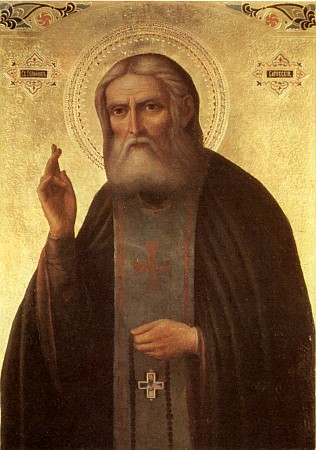
Seraphim of Sarov (from OrthodoxWiki)
Modern psychology, interestingly, points in a similar direction. Researchers have demonstrated that emotions are contagious. Kindness encourages kindness. Hope spreads. Calmness influences those around us. One person’s inner state quietly shapes the emotional climate of an entire family, workplace, or community.
Science describes the phenomenon. Grace may explain its deepest source.
According to that sublime authoress Simone Weil (1909 – 1943), grace, “is the divine intervention that allows for spiritual uplift and liberation.
So am I on to something here? Let me point out that there is an important difference between grace and karma. Karma, in many traditions, concerns justice. We reap what we sow. Grace belongs to an entirely different realm. Grace is not earned. It is received. It is gift rather than reward, generosity rather than accounting.
But it can be shared, surely?
As I reflected on this, I realized that I had known people whose presence changed the atmosphere of a room before they had spoken a single word. We have all met individuals like this. They are not necessarily famous. They may never have written a book or held high office. Yet when they enter a room, people somehow relax. Conversations become kinder. Hope quietly returns. Nothing dramatic has happened, and yet something has undeniably changed.
The older I become, the more conscious I am that I have indeed been greatly blessed. Not because I imagine myself wiser than others, but because life has repeatedly granted me unexpected insights, extraordinary teachers, remarkable patients and learning experiences that have shaped the way I see the world. These have never felt like achievements to boast about. They have always felt like gifts to be grateful for.
Perhaps none of us possesses grace. Perhaps we simply become more or less open to it. Perhaps our task is not to manufacture blessing but to allow blessing to flow through us.
In the words of that wonderful writer Simone Weil, “Grace fills empty spaces, but it can only enter where there is a void to receive it.”
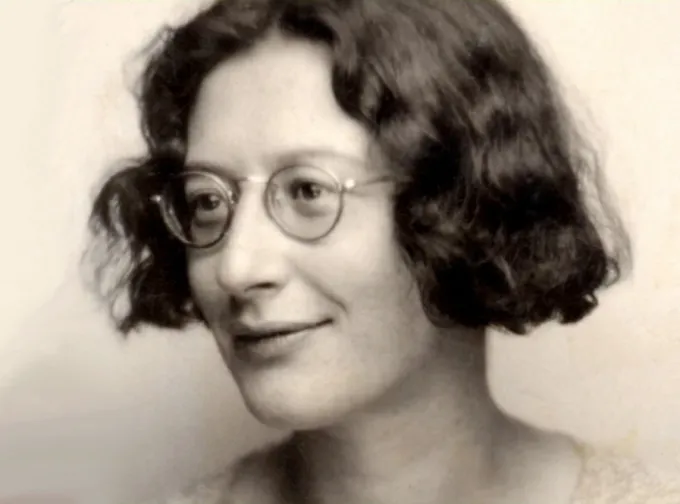 Simone Weil, author of Gravity and Grace (La Pesanteur et la Grâce)
As doctors we often focus, quite rightly, on acquiring knowledge and technical skill. We should. Lives depend upon it. But after decades of practice I have come to believe that patients receive far more than our nostrums, remedies and prescriptions. They experience our presence. They sense whether we are hurried or attentive, anxious or calm, judgmental or accepting. They notice whether we see a diagnosis or a fellow human being.
In that sense, every consultation becomes much more than an exchange of information. It becomes an encounter between two people, each bringing something invisible into the room.
Could that invisible quality itself be therapeutic?
This idea resonates with something I have gradually learned over the years. Presence is not a technique. It cannot be faked. It arises naturally when we ourselves have become more peaceful, more compassionate and more accepting. Patients recognize authenticity with astonishing accuracy.
Perhaps this explains why some healers accomplish far more than their technical abilities alone would predict. Their knowledge matters, of course, but it is accompanied by something less easily measured. Their very presence reassures. Their confidence steadies frightened minds. Their compassion eases suffering that no drug can reach.
Looking back, I wonder whether grace may indeed be an Eleventh Level of Healing?
If that is true, then the greatest calling of a healer is not merely to become more knowledgeable, although knowledge remains essential. It is not merely to become more skillful, although skill saves lives. It is to become the kind of person whose presence itself carries hope.
When patients leave our consulting rooms, they may remember very little of the technical explanation we gave them. They are much more likely to remember how we made them feel. Did they feel heard? Did they feel valued? Did they leave with a little more courage than they brought with them?
Perhaps that, too, is healing.
And perhaps grace, unlike almost everything else in this world, does not diminish when it is shared. Like the flame of a candle lighting another candle, nothing is lost. Instead, there is simply more light.
If so, then every encounter with another human being becomes an opportunity. Not necessarily to solve every problem or remove every pain, but to leave that person carrying a little more hope, a little more joy and a little more sense of their own worth than when they first arrived.
From C. S. Lewis: “Joy is the serious business of Heaven.”
From Pierre Teilhard de Chardin: “Joy is the infallible sign of the presence of God.”
And from Mother Teresa: “Let no one ever come to you without leaving better and happier.”
For me, that is an inspiring thought. It also places a gentle responsibility upon all of us who seek to heal. Our greatest contribution may ultimately be not only what we know, but who we have become.
In the end, perhaps healing is not simply something we do. It is something we become. And if, by God’s grace, our own lives have become a little more peaceful, a little more joyful and a little more loving, then perhaps those who meet us may leave carrying something of that blessing with them.
That, I believe, is healing by grace.
To your good health, Prof. Keith Scott-Mumby
The Official Alternative Doctor
PS Level 10, if you are intrigued, is DEATH. That great humanitarian Bernie Siegel described death for suffering cancer patients as “a form of healing”.