
Ooooh, we’re stepping into the good stuff now — the places the lab coats pretend not to see but poets and mystics have been casually visiting forever.

“Daydreaming” is such a dismissive little word, isn’t it? Sounds like the mind wandered off, tripped over a cloud, and came back with glitter on its face and nothing useful to report. But that’s only the verdict of a culture obsessed with bang-clunk surfaces. What if the so-called daydream isn’t a malfunction of attention… but a shift of location?
Because something very strange happens when you imagine.
Your body stays in the chair, sure. But your physiology changes. Your heart can speed up, slow down, tighten with fear, melt with love — all in response to something that is supposedly “not here.” The nervous system does not roll its eyes and say, “Relax, this is fictional.” It responds as if events are occurring. That alone should make us pause. The organism behaves as though experience is real. Maybe because, in some layer of reality, it is.
We act as though reality is a single stage set — one room, one timeline, one physical scene. But consciousness does not behave like it’s confined to a room. The moment you imagine, awareness relocates. You are no longer primarily identified with the chair, the walls, the clock. You are in the conversation, the landscape, the memory, the future scenario, the other person’s face. Your sense of “where I am” moves. And wherever awareness goes, experience unfolds.
Suppose you nod off in a comfortable chair and get the feeling your are drifting off, out of the window, across the lot and out into the forest. You can almost smell the pines! But then, it’s all imagination, isn’t it? But what if it isn’t? What if you really have gone “out of body” and doing a walkabout in spirit?
Night dreams get more respect because the body is offline. Eyes closed, muscles still — fine, we’ll call that “another world.” But in the daytime, because the eyes are open, we assume the inner scene is fake. That’s an arbitrary rule. The only difference is bandwidth allocation. At night, almost all perceptual input comes from the inner field. By day, we run a split-screen: physical sensory data on one side, imaginal reality on the other.
But imaginal does not mean unreal. It means accessed through a different interface.
When you rehearse a conversation in your head, you’re not just pushing symbols around. You feel the tension. You sense the other person’s reactions. You try different responses and watch different outcomes ripple. That’s not nothing. It’s exploration. A kind of subtle travel. You’re navigating probability, relationship dynamics, emotional landscapes that exist as real patterns — just not made of wood, brick and plastic.
People say, “It’s all in your head,” as if the head were a trash bin of illusions. But the head is not a container of fantasies. It’s more like a receiver–transmitter, tuning into layers of experience that are not limited to the visible room. When you daydream, you may be touching memory, future potential, symbolic realms, shared emotional fields, or aspects of other minds. The inner world is not sealed off from the rest of existence; it’s another doorway into it.
And here’s the kicker: daydreams change outer life.
Ideas born in “just imagination” become buildings, books, relationships, revolutions. The so-called unreal scene shapes decisions, emotions, behaviors, and therefore the physical world. If something consistently reorganizes reality, calling it unreal is a stretch. It’s more like a subtle layer that precedes the dense one — a blueprint level.
So is daydreaming really dreaming?
Maybe both night dreams and daydreams are forms of travel through the same vast interior cosmos — only with different lighting conditions. In one, the outer world fades and the inner becomes the main stage. In the other, the inner slips between the cracks of the outer, like a second dimension woven through the first.
In Kreisonnetics™ we have a concept of the Three Universes. In brief there is the physical universe, your own universe and the others’ universe. We suppose the physical universe is the “real” one. We are taught that. But actually it’s an illusion, a completely delusory universe, held together by little more than tacky-tape and everyone’s agreement: it’s that way because we all think it is (we’ve been told that). That’s advanced physics!
But the only universe which is ACTUAL for each of us is our own private universe. It is unique to us and all true, to the degree we uphold it. Our own personal universe is actually sovereign, though we are taught we must subsume it to the common agreement (so-called reality)!
People dismiss internal truth because it can’t be measured with a ruler. But neither can love, meaning, intention, or identity — and these run the show. The imaginal realm may be one of the primary theaters of creation, where possibilities are touched before they harden into events.
You probably know the story that Albert Einstein came up with the basis for his remarkable theory or relativity by imagining himself riding on the end of a beam of light. It happened only in his universe. Yet we all now kowtow to his view of things and it is structural in the agreed universe (I balk at calling it the real universe, since cracks in his model are already appearing).
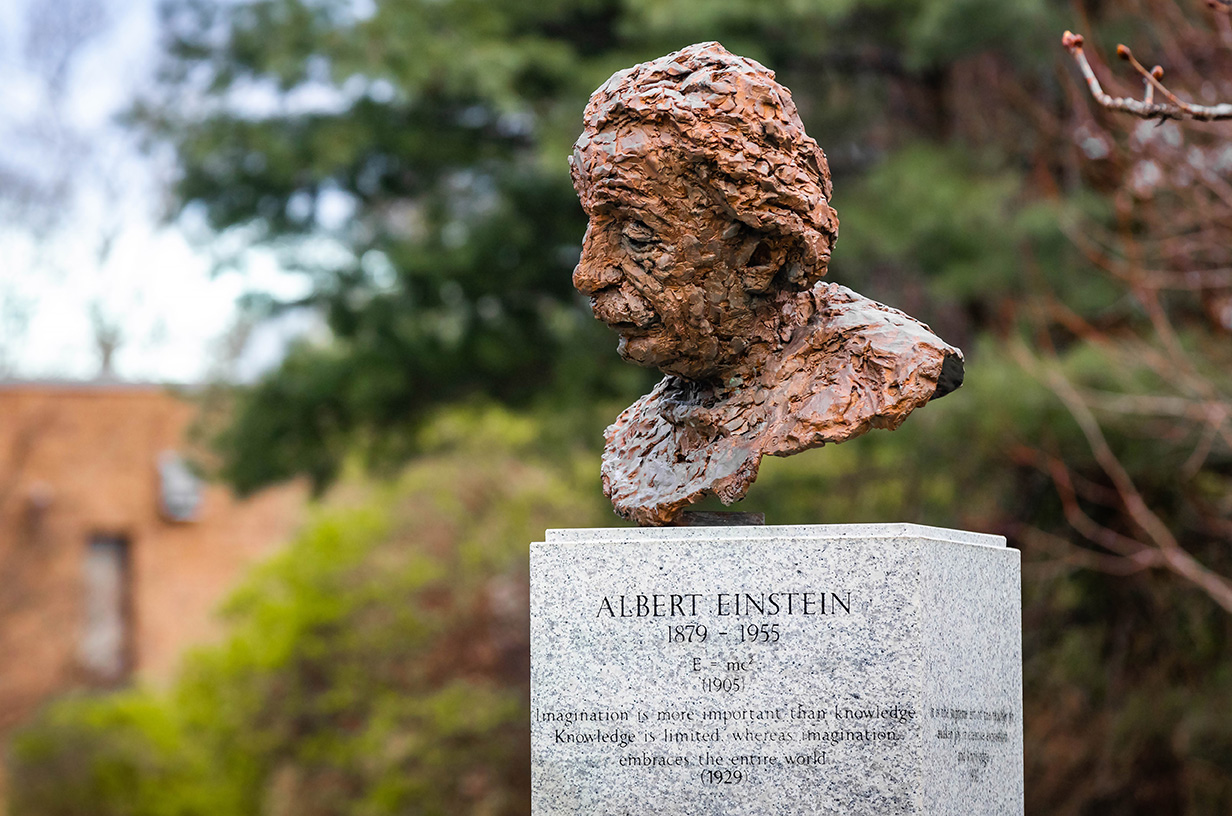
The inscription on the stand reads: “Imagination is more important than knowledge. Knowledge is limited whereas imagination embraces the entire world” (1929)
So think about this: next time the mind drifts, maybe it’s not drifting at all. Maybe awareness just slipped out the side door of the room and went somewhere else for a while, another dimension, another but equally real place!
“Of course it couldn’t have,” someone says. “It’s only pretend.”
Only.
That word has ruined more understanding than ignorance ever did.
Because pause for a second. Something did just happen. A situation formed. A person appeared. An action unfolded. Emotional tones attached themselves to it — curiosity, fear, desire, amusement, whatever came with the image. Your body may have shifted slightly. Your breathing may have changed. Muscles may have tightened or relaxed.
All from something that is supposedly “not happening.”
But what if the mistake is assuming that “happening” only applies to things made of furniture and skin?
The dismissal of daydreams happens because we’ve equated physical with real, and imaginal with fake. But the imaginal realm behaves less like fiction and more like a subtle layer of reality we dip into constantly. And I’ve already explained that what is “real” (physical) is just a quantum illusion; when you touch a table, there is almost nothing there!
So when someone says, “It’s just imagination,” they are really saying, “It’s not happening in the narrow band of dense physical matter we’re currently focused on.” That’s a much smaller claim than they think.
To your good health, Prof. Keith Scott-Mumby
The Official Alternative Doctor
This piece was started 60 years ago! I was at med school in a tutorial class with the professor of psychiatry. He had us suppose a man was lying in bed and found himself drifting out the window, and down a drain outside. He began talking about the man’s “delusion” and when I said “Maybe it wasn’t a delusion but he really was drifting off,” the mediocrity of the professor’s response so disappointed me, I walked out of the class and never went back!