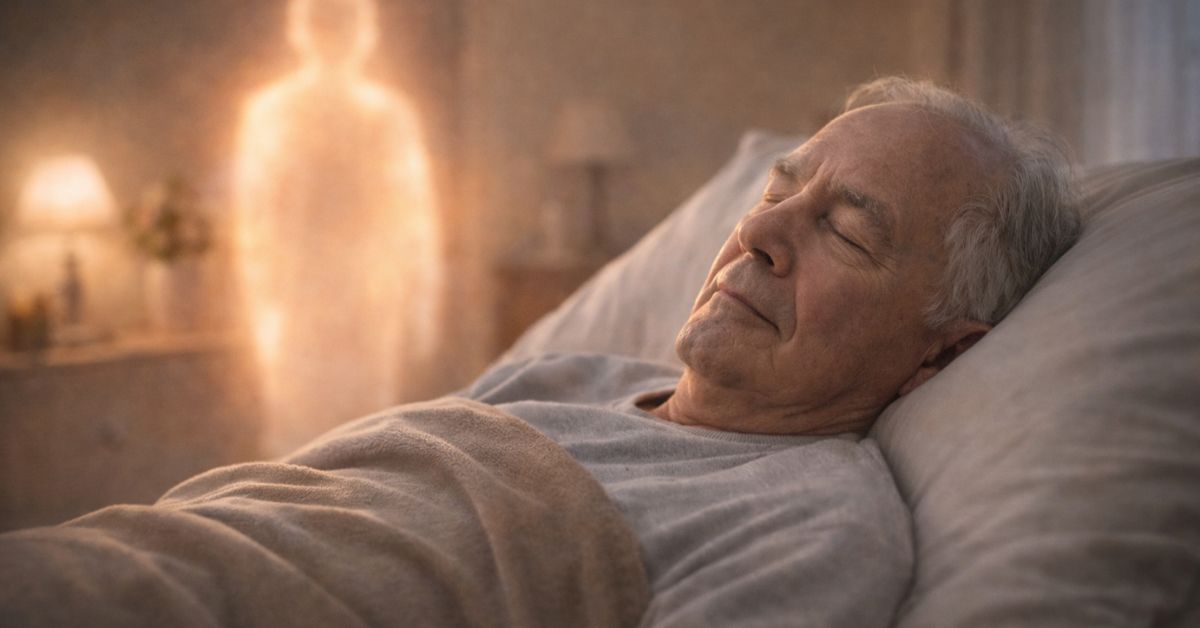
Comfort in dying.
Researchers at the Center for Hospice and Palliative Care in Cheektowaga, New York interviewed 66 patients in the weeks leading up to their deaths about the content of their dreams and found that almost all experienced dreams and visions involving deceased and living friends and relatives. Virtually all were described as feeling intensely real; about one third of the visions occurred while they were awake.¹
The majority of these dreams and visions were described as comforting and reassuring, especially those involving deceased friends or relatives. Some described encounters with childhood friends, others with long-dead parents and grandparents. One 91-year old woman dreamed of meeting her mother in a garden who reassured her that “everything will be okay;” others dreamed of parents and siblings who hugged and told them they loved them. Still others dreamed of angels, God, or a beloved dog from childhood.
A common theme of many dreams was that of preparing for a journey. Some of those interviewed spoke of wanting to die and to join their loved ones, and of having been told it wasn’t their time yet.
The researchers found that the closer the dreams were to the person’s death, the more comforting they became. Likewise, the presence of end-of-life dreams and visions was predictive of a peaceful and calm death.
This study helps us to better understand the final stages of death, and encourages us to be reassured—rather than alarmed—by the presence of these kinds of vivid dreams and visions in the dying. By understanding and being able to talk openly about these dreams with the dying, it becomes possible to share in their acceptance of death as the natural conclusion to life that it is, to comfort them, and to be comforted.

In a 2015 TED talk, a clip was shown of a lucid, terminally ill patient discussing her deathbed visions. “My mom and dad, my uncle, everybody I know that was dead was there,” she said. “I remember seeing every piece of their face.” Other hospice nurses have related similar experiences with dying patients claiming to be surrounded by large groups of “ghosts.”
A small but important 2014 study of hospice patients concluded that “most participants” reported such visions and that as these people “approached death, comforting dreams/visions of the deceased became more prevalent.”
This visitation phenomenon is even becoming commonly accepted in the mainstream medical field, as illustrated by this entry about dying that appears on the website WebMD:
“Hallucinations and visions, especially of long-gone loved ones, can be comforting. If seeing and talking to someone who isn’t there makes the person who’s dying happier, you don’t need to try to convince them that they aren’t real. It may upset them and make them argue and fight with you.”
Of course what’s really stupid about this advice is the article did not even entertain the remotest possibility that a long-dead person could actually be present, in a non-material sense. The real reason you shouldn’t argue is that YOU may be wrong and the patient is right.
Modern science is far too narrow-minded and arrogant!
Calling You Home
I have seen this visitation phenomenon countless times on the wards; the patient is finally being beckoned over to the other side by a friendly spirit. Nurses know this, of course; they see it often but don’t mention it to the doctors… at least not the male doctors! But obviously there is a presence there. It’s a ghostly immaterial apparition that is calling the patient over at the moment of dying.
You witness the terminal patient making gestures, apparently talking to someone at the end of the bed, some specter; someone who isn’t there. Sometimes there is a friendly smile of recognition, as if the patient already knows this being.
And then, next thing, he or she is gone from us.
According to an article in The Miami Herald, July 23, 2017, these visitations are very common among dying patients in hospice situations,” Rebecca Valla, a psychiatrist in Winston-Salem, N.C., who specializes in treating terminally ill patients, wrote in an email. “Those who are dying and seem to be in and out of this world and the ‘next’ one often find their deceased loved ones present, and they communicate with them. In many cases, the predeceased loved ones seem (to the dying person) to be aiding them in their ‘transition’ to the next world.”²
I suspect this happened with my Mum. She and her ex-husband, who died within a day of each other (their obituaries were only an inch apart in the local rag!), probably went through this ritual.
I wasn’t there. I’d flown home to Las Vegas. But the nurses say that Mum was fine when they went round to do her vitals at 2.00 am, laughing and joking, and yet when they came again, at 3.00 am, she had passed. I can imagine it easily, having seen it so often. The non-material presence appears and beckons… it might even have been her first husband, my own Dad, saying “Come on Flo, it’s time.” By then she would be halfway to the other side anyway, having left our world and was already peeping into the next.
I think she would have found it comforting to find someone she knew and trusted, to help her make that final, eventful step!
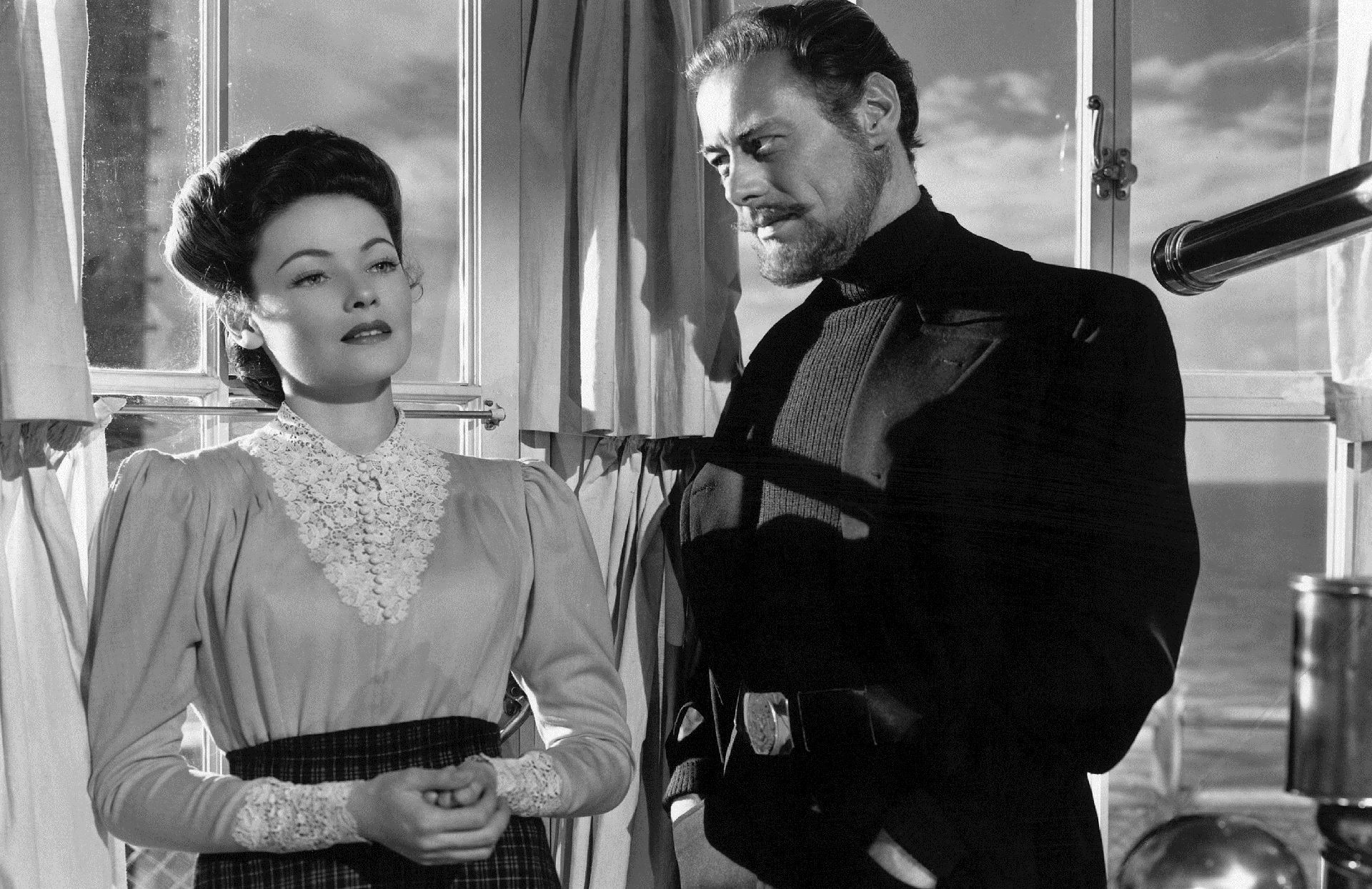
It’s part of what’s called Nearing Death Awareness. I call it the “Mrs. Muir Effect”, after a wonderful sweet movie called The Ghost and Mrs. Muir. It starred Gene Tierney, as Mrs. Muir, and Rex Harrison as the cantankerous ghost of Captain Daniel Gregg, who originally owned Gull Cottage, the house Mrs. Muir has bought for herself and her daughter. At the end of her life Mrs. Muir is called for by the ghost of Daniel Gregg, who escorts her into the afterlife! Hence my expression, The Mrs Muir Effect.
There’s not a scary moment in the whole story; just love, courage and reverence. It turns out in the end that even the daughter (played by a young Natalie Wood) had seen the ghost and talked to him often, without the least fear.
Death Visions
There is no question that patients find these encounters comforting. It’s not really surprising, that evidence of some part of us surviving should lessen the fear of dying or oblivion. In other words, these dreams are therapeutic. However, end of life visions are not confined to just meeting dead friends and relatives; arguably this is just one aspect of a larger transformation, which centers around end of life dreams and visions (EOLVs).
Sometimes patients dream of heaven or the afterlife. Others dream of starting out on a journey. Some patients are ready to die, even want to pass over, but they get a message from the other side that their time is not yet.
Though many people have reported this phenomenon, a study out of Canisius College in New York in 2014 was one of the first pieces of serious research into the subject. Researchers interviewed 66 patients who were receiving end-of-life care and said they saw at least one vision per day, mostly through dreams.³
“As participants approached death, comforting dreams/visions of the deceased became more prevalent,” the researchers wrote. “The impact of pre-death experiences on dying individuals and their loved ones can be profoundly meaningful. … These visions can occur months, weeks, days or hours before death and typically lessen fear of dying, making transition from life to death easier for those experiencing them.”
50 to 60 percent of patients experience these visions — though that number may actually be higher since “families and clinicians knowingly under-report these experiences for fear of judgment, ridicule and embarrassment,” according to Nursing Times.
No question, ELDVs are therapeutic.
“They bring about a sense of peace, a change in perspective or an acceptance of death, suggesting that medical professionals should recognize dreams and visions as a positive part of the dying process,” according to Scientific American.
Of course there is always the implication by dyed-in-the-wool scientists that these dreams and visitations are mere delusions. It never occurs to them that non-material events can be quite real. Non-material does not mean not real; just not in the material world frame. Indeed, some are and there are stories of two or more people seeing a non-material specter at the same moment. That makes dismissing them as delusions more difficult. You have probably read they have come up with the term “mass delusion” when an event is so real that many people can see it!
Most “miracles” documented by the Catholic Church would qualify as mass delusions (Lourdes, for instance; Knock in Ireland). That doesn’t mean they are not real, does it?
Really, we don’t need to concern ourselves with “explanations”. The fact is that visitations and dreams are so vividly real to the patient, that family and carers should assume the terminally-ill patient is having a real experience and talk with them as though it were totally real and perfectly natural, which is it.
Be happy for the patient!
To your health, Prof. Keith Scott-Mumby
The Official Alternative Doctor
References:
- J Palliat Med. 2014 Mar;17(3):296-303. doi: 10.1089/jpm.2013.0371. Epub 2014 Jan 11
- https://www.miamiherald.com/news/nation-world/national/article163172878.html
- Kerr, Christopher W., James P. Donnelly, Scott T. Wright, Sarah M. Kuszczak, Anne Banas, Pei C. Grant, and Debra L. Luczkiewicz.
“End-of-Life Dreams and Visions: A Longitudinal Study of Hospice Patients’ Experiences.” Journal of Palliative Medicine17, no. 3 (March 2014): 296–303.