It’s the same old mantra: vaccines are “safe and effective”. Neither is true but they keep chanting it till they believe it (like a religion) and they attack and are vengeful with any who oppose their view (like a religion)!
I’m not anti-vaccination, in principle, as you know. I’ve written a dozen times over the years that I’m glad to live in a world where there is a rabies vaccine, thanks to Louis Pasteur. It’s a horrible illness and the vaccine is about 99% effective, if given in time.
BUT THE RABIES VACCINE IS NOT WITHOUT RISKS! I have never claimed that. In fact it’s pretty unpleasant stuff. There are no recorded deaths from the modern vaccine, though it carries a high rate of mild, temporary reactions. Because rabies is virtually 100% fatal once symptoms appear, the benefits of the vaccine drastically outweigh the risks of any complication.
That’s safe AND effective.
But take Hep A and B. The hepatitis A vaccine is recommended for “high-risk” children and adults, while the hepatitis B vaccine is recommended for all adults under 60 years. All infants in the USA are given Hep B on their first day of life. Yet in a recent study, published in JAMA, researchers estimated that only 40% of U.S. adults had immunity to hepatitis A and only 27% were immune to hepatitis B virus.
They described that as “suboptimal”. I would be tempted to use the word “crap”.
What about, say, measles? The measles vaccine, as you probably know, has been touted as one of the greatest advances in modern medicine that “saved” us all from a deadly fatal disease. Surely that is “safe and effective”? No, that’s nonsense. To begin with, measles had all but vanished as a problem by the same time that the vaccine was introduced. (see chart)
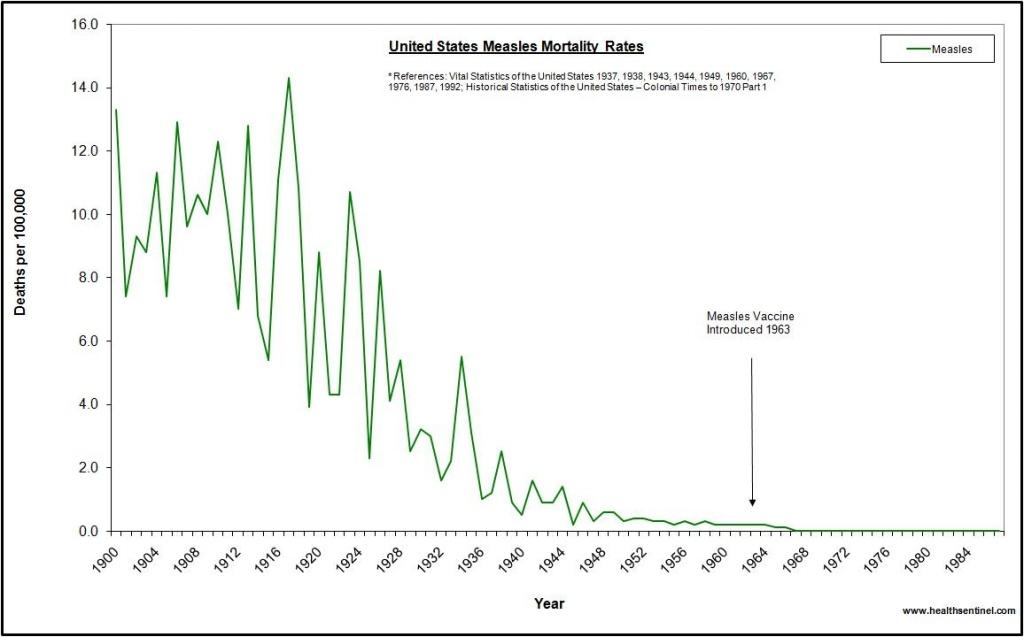
Before measles vaccine was ever invented, the deaths due to measles had dropped from all-time highs of 10,000s per year to 100 per year. Some of this we know had a lot to do with better hygiene, sanitation, electricity, transportation of food, refrigeration, labor laws, and nutrition.
But there is another factor, rarely mentioned, but which I consider likely crucial. Vitamin A dosing.
You will know that I personally choose vit A as the “antibiotic vitamin”, not D as some try to maintain. In the 40s and 50s kids in the Western world were widely dosed with cod-liver oil, which contains lots of vitamins A and D.
Did you know that high-dose vitamin A is the RECOMMENDED treatment for serious measles cases, listed on the CDC website?1
Secondly, measles was never a scary threat in the way that scaremongers try to make it out today. In 1962 the disease was described by Alexander D. Langmuir, then Chief Epidemiologist at the U.S. Communicable Disease Center (the forerunner of today’s CDC), as being “a self-limiting infection of short duration, moderate severity, and low fatality…”2
Yet today, with all the fear mongering, you would think that measles is about to carry off all our young children!
Measles is, of course, a real disease, and while it can have serious complications, it is largely determined by an individual’s immune status. Before widespread vaccination campaigns, measles was a common childhood illness that conferred lifelong immunity. Now, due to waning vaccine-induced immunity, adults—who are at higher risk for complications—are increasingly affected by outbreaks.
It’s not working! But they disguise this by counting “don’t knows” as unvaxxed, where it’s a fact that over 85% of the population are technically vaxxed. They boast that.
Additionally, while the measles vaccine is heavily promoted as safe, a growing body of evidence reveals dozens of serious adverse events associated with the MMR (measles, mumps and rubella) vaccine.
Some of you know I was probably the first MD in the world (1983) to point out that youngsters tended to develop autism disorders after receiving the MMR (I mean within days, not months or years. After you’ve seen a dozen cases in a month, all with the same story, you don’t need researchers and “investigators” (read shills) looking for clusters and “proving” there is no connection.
You KNOW it is a pattern.
The connection with autism remains controversial and is clouded by arguments as to whether mercury (thimerosal) is the problem, which it appears not to be.
But there are many other complications of this tricky-treacherous vaccine, which is thus neither safe nor effective.
These well-documented risks raise critical questions about the one-size-fits-all vaccination policy being enforced through mandates. The notion that every child must be vaccinated without consideration for individual risk factors ignores the reality that vaccines—like any medical intervention—carry risks that must be weighed against their benefits, not just weighed against loss of profits.
Take another one; good old flu!
There are, in fact, over 200 viruses (and even some bacteria) that cause influenza and influenza-like illness (ILI), all producing the same or similar symptoms (fever, headache, aches and pains, cough and runny noses). Without laboratory tests, doctors cannot tell real flu from ILI. Both last for days and only rarely lead to death or serious illness. At best, vaccines might be effective against only Influenza A and B, which represent only about 10% of all circulating viruses.
Unfortunately, flu shots are just about worthless. Oh sure, they can trot out reams of spun figures to show how crucial it is to get your annual jab. But does it really do any good? And is it really as safe as they claim; that even children and babies should get “harmless” flu shots?

I’ll start by addressing the second question first:
“… the swine-flu vaccination program was one of the CDC’s greatest blunders…In 1976 health officials launched a 100-million dollar program to immunize every American. But the expected epidemic never materialized, and the vaccine led to partial paralysis in 532 people. There were 32 deaths.”3
So much for the continuous chant that vaccines are “safe”. So what about “effective”?
Based on U.S. surveillance network data from September 2025 to February 2026, estimated vaccine effectiveness (VE) rates against influenza A- and influenza B-related outpatient visits for adults ranged from 22% to 34%, which is absolutely dismal, and 30% to 41% for those ages 65 and older. That’s the group they claim that the vaccine is most needed for and does the most good! 30 – 40% effective? Nah. I don’t think so.
Among children and adolescents ages 6 months to 17 years, VE rates against outpatient visits ranged from 38% to 41%, hardly impressive. “These findings support CDC’s recommendation for annual influenza vaccination,” they concluded.4
No they absolutely do NOT! 22-30% protection? That’s not effective in my book.
Did you know that science says that it takes 71 people to be vaccinated against flu, to prevent even one case and 29 healthy adults need to be vaccinated to prevent one of them experiencing an ILI? No, I suppose not, since the medical industry doesn’t WANT you to know!
Add this… Last year.
In adults ages 65 and older, with standard-dose inactivated influenza vaccines, the effectiveness was just 16%. And that’s the age group they claim it does the most good!
Unfortunately, lying and deceit seem to be the normal business protocols in the pharmaceutical industry. You owe it to yourself and your loved ones to stay informed.
 Prof. Keith Scott-Mumby
The Alternative Doctor
References:
- https://www.cdc.gov/measles/media/pdfs/2026/05/measles-prevention-and-treatment-overview.pdf
- Langmuir AD. Medical Importance of Measles. American Journal of Diseases of Children. 1962;103(3):224–226. doi:10.1001/archpedi.1962.02080020236005
- U.S. News and World Report, Joseph Carey, October 14, 1985, p. 70, “How Medical Sleuths Track Killer Diseases.”
- https://www.cdc.gov/mmwr/volumes/75/wr/mm7509a2.htm