
Our later life is perhaps dictated even more by expectations than biology. Over half a century ago people believed (they “knew”) that, if you were lucky and made it to retirement, at 60 years of age, you then rapidly fell away and died as a kind of crock between 65 and 70. That’s just what people do, was the common perception.
Of course there were exceptions and that shortfall didn’t apply to the Okinawans, Ikarians, Hunzas or other isolated groups. But nobody counted them and their ways, until starting around maybe the 80s. Interest in natural longevity gradually expanded over the years to become the “blue zones” concept, popularized by Daniel Buettner, a National Geographic Explorer and Fellow, and Emmy-Award winning journalist. A blue zone is a territory with an extraordinary high concentration of healthy old people, notably centenarians.
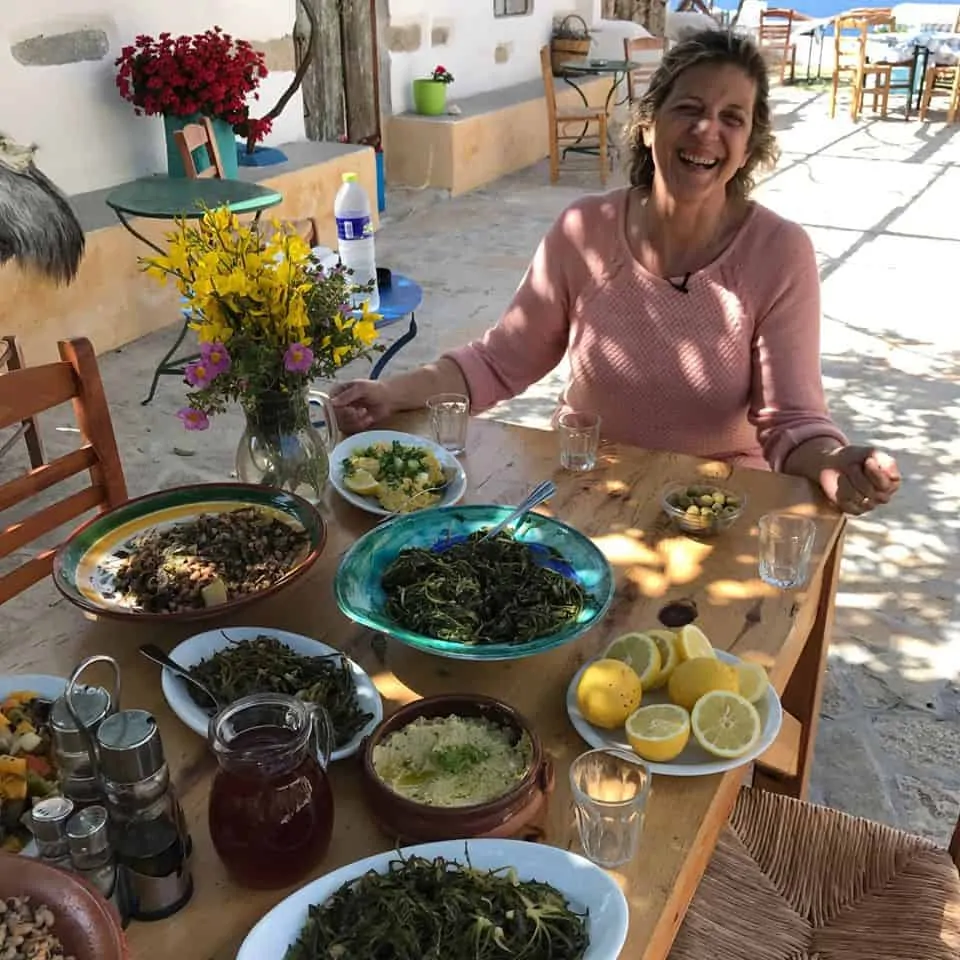 A healthy Ikarian (Blue Zones) Diet
Note that I said healthy: a large population of doddery dotards would mean nothing. Just some trick of the light perhaps! But if they live far longer than most AND keep their health faculties in good working order, that’s the start of a path to discovery, surely?
Up until the twenty first century the perception of aging was that it was inevitable. We had no control over it. Attitude of mind was irrelevant. Sooner or later you began to crumble and descend into a miserable dotage of frailty, cognitive impairment, aches and pains and severe limitation of movement.
Some years ago I wrote a piece titled Do You Want To Be An Old Crock Or A Classic Car? The difference between a rust-bucket old banger that has to be sent to the crushers and a decades-older beautiful smooth-running classic car is simple and obvious: the classic car has been properly looked after. We should treat our bodies in the same way and take care of them; otherwise you will become an old crock. The conclusion is still valid and the piece continues to change reader’s perceptions.
A lot of people I talked to at the time had a blunt-force thinking attitude of “I don’t care. I don’t want to grow old and suffer. I’d rather die.” This was very unfortunate because, like it or not, people were starting to live longer and longer, but not necessarily healthily. By the time you reach 80-some and are suffering from stooped posture, aches and pains, limitation of movement, difficulty remembering, incontinence and other indignities of old age, it’s too late to have a change of heart. You have ruined your prospects of a zestful old age and must pay the price.
[Of course it’s never too late to make wise and health-giving changes and derive at least some benefit]
The point is that people get what they expect to get. If you are sold into the story that old age is an infirmity, you can expect a fairly unpleasant ride through your dotage.
And don’t listen to dismissive doctors. Most of them go on with the same old line, “Aging is inevitable. There’s nothing you can do about it. You just have to put up with it.” It’s errant nonsense. Any doctor who utters those words is criminally bad, or just plain ignorant. You want to work with a doctor who offers detailed advice about diet and nutrition, staying active, keeping inflammation at an absolute minimum and, above all, setting the right positive mental attitude. “You are what you eat” is an old, old trope in medicine but there is also a twin phrase, equally valid: you are what you think you are!
Now we Boomers (and the up-and-coming Gen-X, Millennials and Gen-Z) are well served by a positive and fun-loving approach to life. It’s been my slogan for decades that we Boomers want to go on partying till our last day on earth. That brings up an important health definition: it is to distinguish between lifespan and so-called “healthspan.” Lifespan is how long we remain alive; healthspan means how many of those years are healthy, enjoyable and trouble-free.
Ideally we want the two measures to be very close. Get rid of the idea of your “final years”, meaning the difficult troubled times as you struggle to cope. If you wake up one morning, healthy and zestful, have a great day and then go to sleep, never to wake up, that’s a great ways for it all to end, you’ll agree.
That’s the benchmark to aim for. It’s the exit I preach!
Brain Health
Now, let’s separate out the issue of brain health and talk about that. We are not a brain, there is abundant evidence for that statement but it is completely ignored by the establishment. There are individuals walking around with next to no brain (less than 1%) and yet no-one can tell there is anything amiss; memory is excellent. One case known to me went to college, got a degree and began to practice accountancy.
But our brain is still important. It’s the main biological organ for connectivity with the outside world. So we should rightly look after it and be concerned for its effective functioning. Not surprisingly, brain health is now the number one concern for elders, ahead of cardiovascular health and cancer prevention (AARP 2025 Health Priorities Survey).
Yet decades of obsession with low-fat diets has done much damage. It’s a misguided obsession with the supposed harms of saturated fat, built on false science perpetrated by Ancel Keys in the 1970s (he was being paid by the sugar industry to distract attention from the damage cause by high sugar intake). He simply faked or distorted his findings by omitting countries with a high fat intake and good health and omitting countries with a low fat intake that were overall unhealthy.
Here are 2 graphs, the first that Ancel Keys published (which looks convincing) and the second is with all the countries he studied included, which shows virtually no connection between heart disease and fat intake:
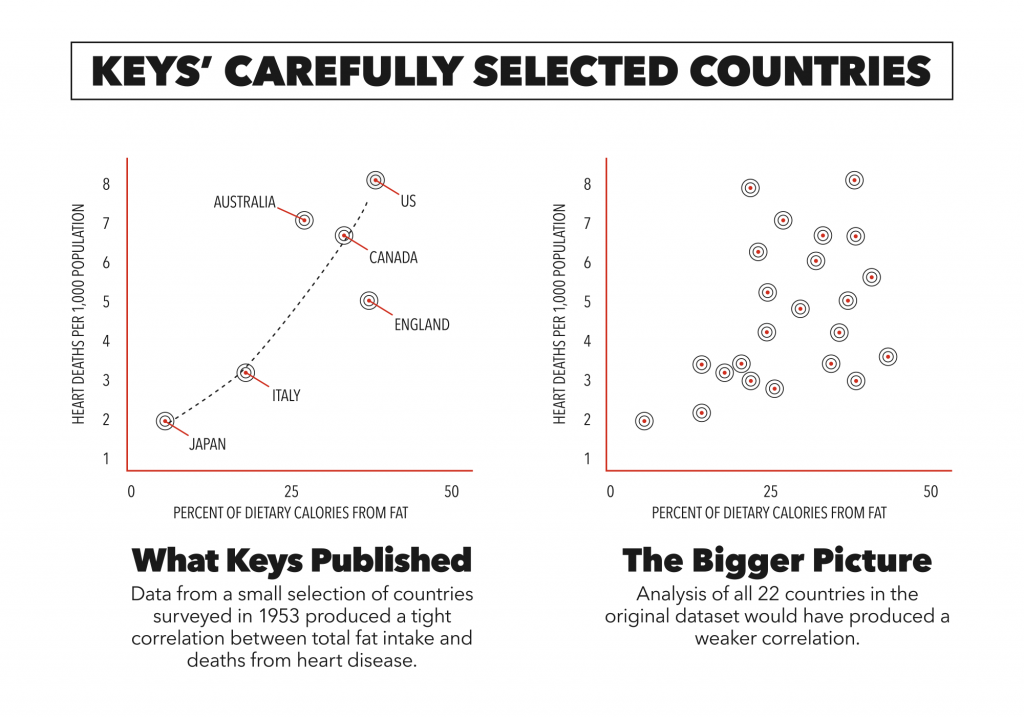
It took nearly fifty years for the facts to emerge and there are still die-hards who won’t give up their pet hypothesis that fats are bad for us. Unfortunately, our brains are around 60% fat. So for decades we have been starving our brains and the result is an epidemic of dementias. Moreover heart disease, which was supposed to be being solved by Ancel Keys’ research, has continued to rise, relentlessly. So he was well wide of the truth – but that was his aim.
The story of cholesterol runs along similar tracks. Cholesterol has been demonized to the extent that people fear it as deadly and take complex drugs, with dangerous side effects, to combat it. The aim is to get your cholesterol levels as low as is possible. Yet our brains hold 20% of the total cholesterol in your body! Fighting against cholesterol is to deprive and damage your brain!
Science gets very muddled when big business dollars get into the mix and distort the truth. Ain’t that so!
The Official Alternative Doctor